RBT® Training Options
✅ 87.2% first-time pass rate on the RBT® board examination!
💬 AI-powered practice support!
When ABA is working, you can see it, but what makes it real (and clinically useful) is what you can measure. In the ABA Training and Certification Center (ATCC®) 2026 RBT® Training (3rd Ed.), Chapter 14: Common Data Collection Procedures, you learn how RBT®s gather accurate, reliable data to track client progress, guide interventions, and prepare for the RBT® exam. This chapter aligns with the RBT® Test Content Outline (3rd ed.) measurement expectations, including continuous measurement, discontinuous measurement, and permanent product recording—so treatment decisions are based on evidence, not guesswork.
The “right data” = the right decisions
Different behaviors call for different measurement tools—because not every target can (or should) be counted the same way. Chapter 14 breaks these methods down in a clear, practical way:
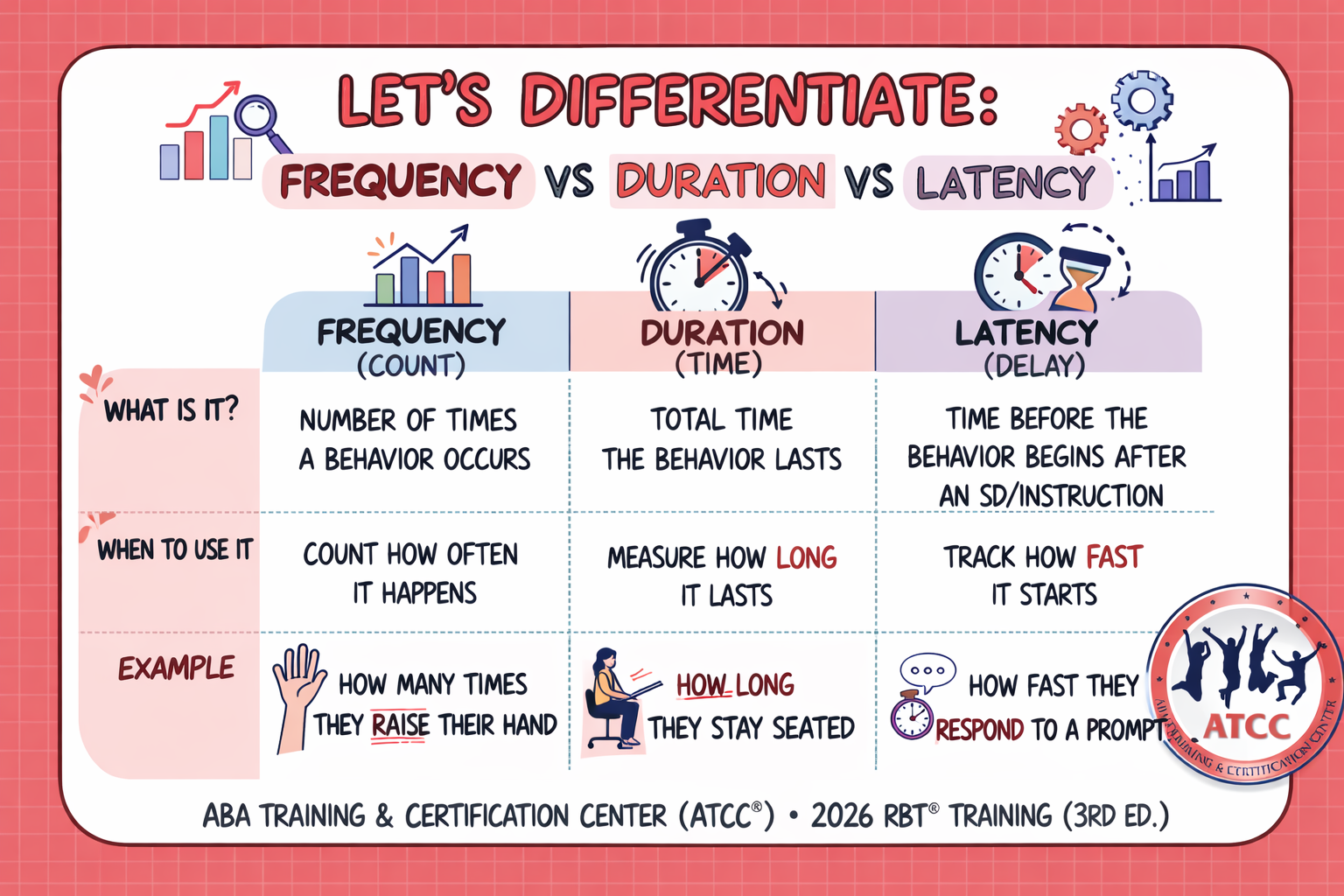
Continuous measurement (captures every occurrence):
Frequency/Count:how many times a behavior happens
Duration: how long the behavior lasts
Latency: how long it takes for the behavior to start after an SD/instruction
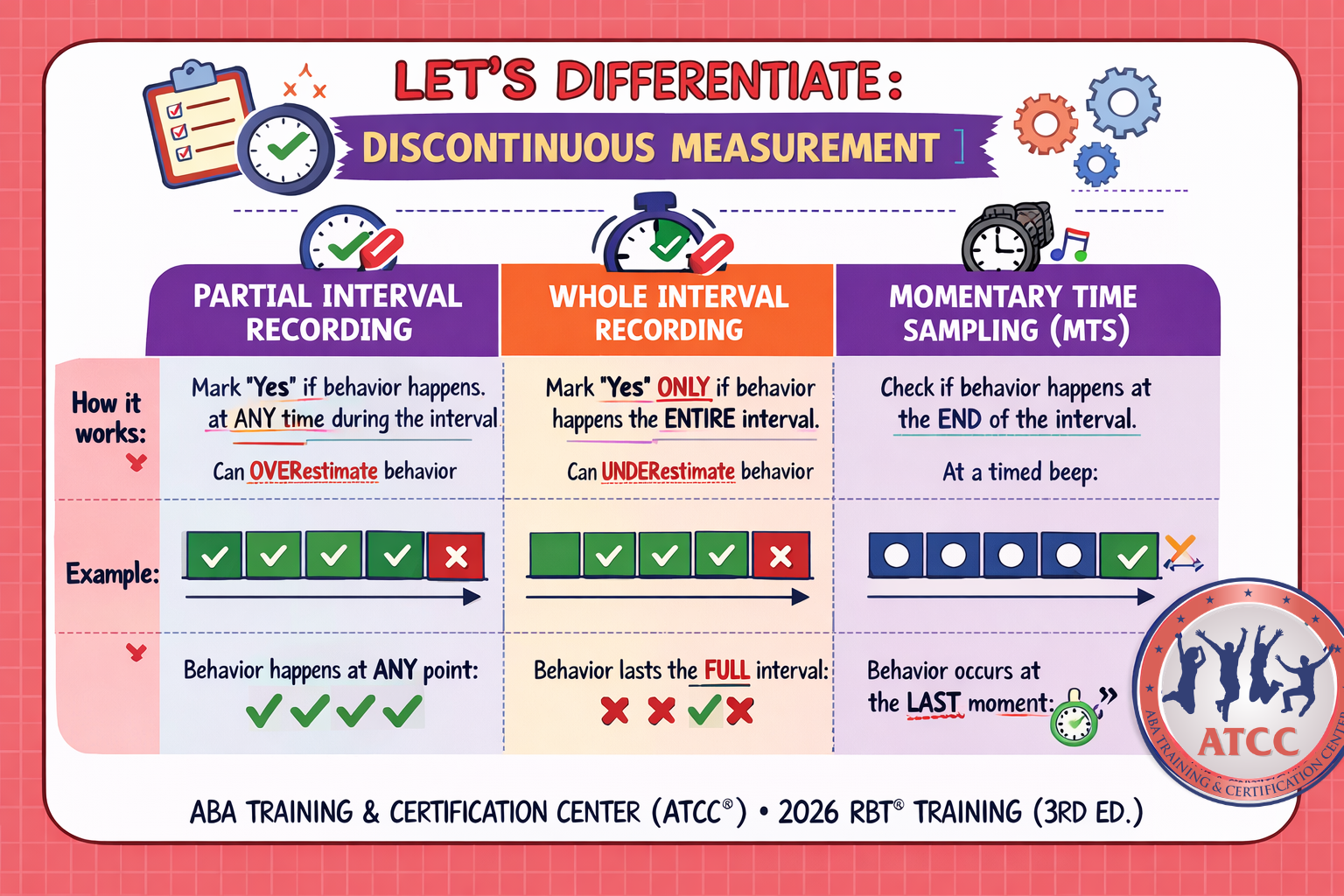
Discontinuous measurement (samples behavior over time):
Whole Interval Recording: mark “yes” only if the behavior happens for the entire interval — this can underestimate behavior
Momentary Time Sampling (MTS): check if the behavior is happening at the exact moment the interval ends (or at a timed beep) — great when you’re multitasking or tracking groups.
Why this matters for RBT®s (and for the exam)
Data collection is one of the most powerful tools you have as an RBT®—because the data tells the story when memory, emotion, or assumptions can’t. When you collect data accurately and consistently, you’re able to clearly demonstrate whether a skill is improving, whether a behavior is decreasing, and whether an intervention is actually effective. Instead of saying “it seems better” or “today was hard,” you can point to measurable trends and objective information that guide clinical decisions.
Strong data also builds your professional credibility. It shows supervisors and team members that you are attentive, consistent, and committed to high-quality care. When patterns emerge—such as behavior increasing during certain tasks or decreasing with specific supports—you become an active contributor to treatment progress, not just a passive implementer. Ultimately, accurate data protects the integrity of services, supports ethical practice, and ensures that every decision made truly benefits the client.
Quick Pro Tip: How to Choose the Right ABA Measurement Method (RBT® Guide)
Choose your measurement based on what you’re trying to learn. The goal isn’t to “collect data” just to collect it—the goal is to pick the method that gives the clearest, most useful picture of the behavior.Use Frequency (Count) when you’re tracking quick bursts
Best for behaviors that start and stop fast
Examples: calling out, tapping, hand-raising, hitting, requests
Ask yourself: “How many times did it happen?”
Use Duration when time is the main concern
Best when the behavior can last for a while
Examples: tantrums, time on-task, crying, time spent engaged in play
Ask yourself: “How long did it last?”
Use Latency when you’re measuring response time
Examples: time to start a task after an instruction, time to transition, time to respond to a question
Ask yourself: “How long did it take to begin after the cue?”
Use Discontinuous Measurement when continuous tracking isn’t realistic
Best for busy sessions, group settings, or when you’re juggling multiple responsibilities
Options include: partial interval, whole interval, and momentary time sampling
Ask yourself: “Can I sample this accurately over time instead?”
Build Real RBT® Confidence with Measurement Skills
At ABA Training and Certification Center (ATCC®), we believe strong RBT®s are built on strong measurement skills. Anyone can memorize terms—but confident technicians understand why they are choosing frequency over duration, or interval sampling over continuous measurement. That level of clarity is what separates entry-level knowledge from true clinical readiness.
Keep Learning with ATCC®

1-877-770-2822
SUPPORT@ATCCONLINE.COM
AFFILIATE PROGRAM
CONTACT US