RBT® Training Options
Write your awesome label here.
✅ 87.2% first-time pass rate on the RBT® board examination!
📚 4 study resources, $1,196 value — now free upon completion of the ATCC® 40-hour RBT Training course.
💬 AI-powered practice support!
💬 AI-powered practice support!
If you're learning to become a Registered Behavior Technician (RBT), there are three letters you are going to see again and again:
A. B. C.
No, we are not going back to kindergarten.
In Applied Behavior Analysis (ABA), ABC stands for Antecedent, Behavior, and Consequence. ABC data collection is a way of recording what happened before a behavior, what the behavior looked like, and what happened immediately afterward. It sounds simple, and the basic idea really is. The tricky part is learning what to write, what not to assume, and how to keep your observations objective.
Let’s break it down.
A. B. C.
No, we are not going back to kindergarten.
In Applied Behavior Analysis (ABA), ABC stands for Antecedent, Behavior, and Consequence. ABC data collection is a way of recording what happened before a behavior, what the behavior looked like, and what happened immediately afterward. It sounds simple, and the basic idea really is. The tricky part is learning what to write, what not to assume, and how to keep your observations objective.
Let’s break it down.
What Is ABC Data Collection?
ABC data collection is a direct observation method used to record the events surrounding a behavior.
Think of it as taking a snapshot of what happened:
A — Antecedent: What happened immediately before the behavior?
B — Behavior: What exactly did the individual do?
C — Consequence: What happened immediately after the behavior?
When ABC data are collected across multiple occurrences, the supervising behavior analyst can examine the information for patterns that may help inform assessment and treatment decisions.
One important distinction: ABC data can help reveal patterns, but a few ABC observations alone do not prove why a behavior is happening.
That is why accurate data collection matters.
For RBTs, this is also an important skill to learn. ABC data collection is currently included in the Assessment section of the BACB's RBT Initial Competency Assessment.
Think of it as taking a snapshot of what happened:
A — Antecedent: What happened immediately before the behavior?
B — Behavior: What exactly did the individual do?
C — Consequence: What happened immediately after the behavior?
When ABC data are collected across multiple occurrences, the supervising behavior analyst can examine the information for patterns that may help inform assessment and treatment decisions.
One important distinction: ABC data can help reveal patterns, but a few ABC observations alone do not prove why a behavior is happening.
That is why accurate data collection matters.
For RBTs, this is also an important skill to learn. ABC data collection is currently included in the Assessment section of the BACB's RBT Initial Competency Assessment.
Meet the A: Antecedent
Now the B: Behavior
Finally, the C: Consequence
Putting It All Together: An ABC Data Example
Let's look at a complete example.
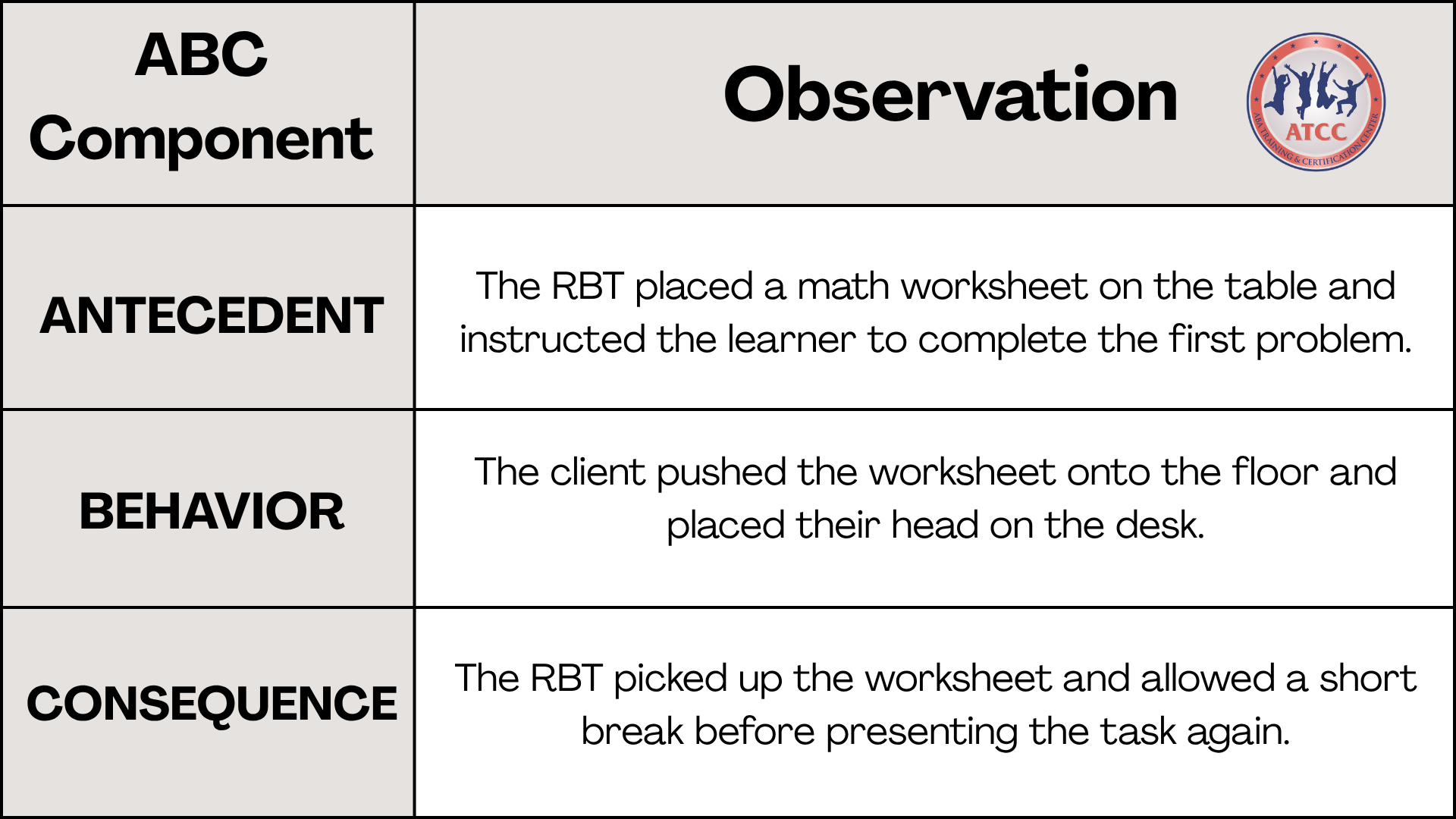
See how factual the description is?
We are not saying:
"The client hated math."
We are not saying:
"The client was trying to escape."
We are simply documenting what happened before, what happened, and what happened next.
Later, a qualified supervisor can examine ABC data collected across multiple observations and consider whether meaningful patterns are present.
The Difference Between Observing and Assuming
One of the biggest skills an RBT develops is learning to separate observation from interpretation.
Consider these examples:
Consider these examples:
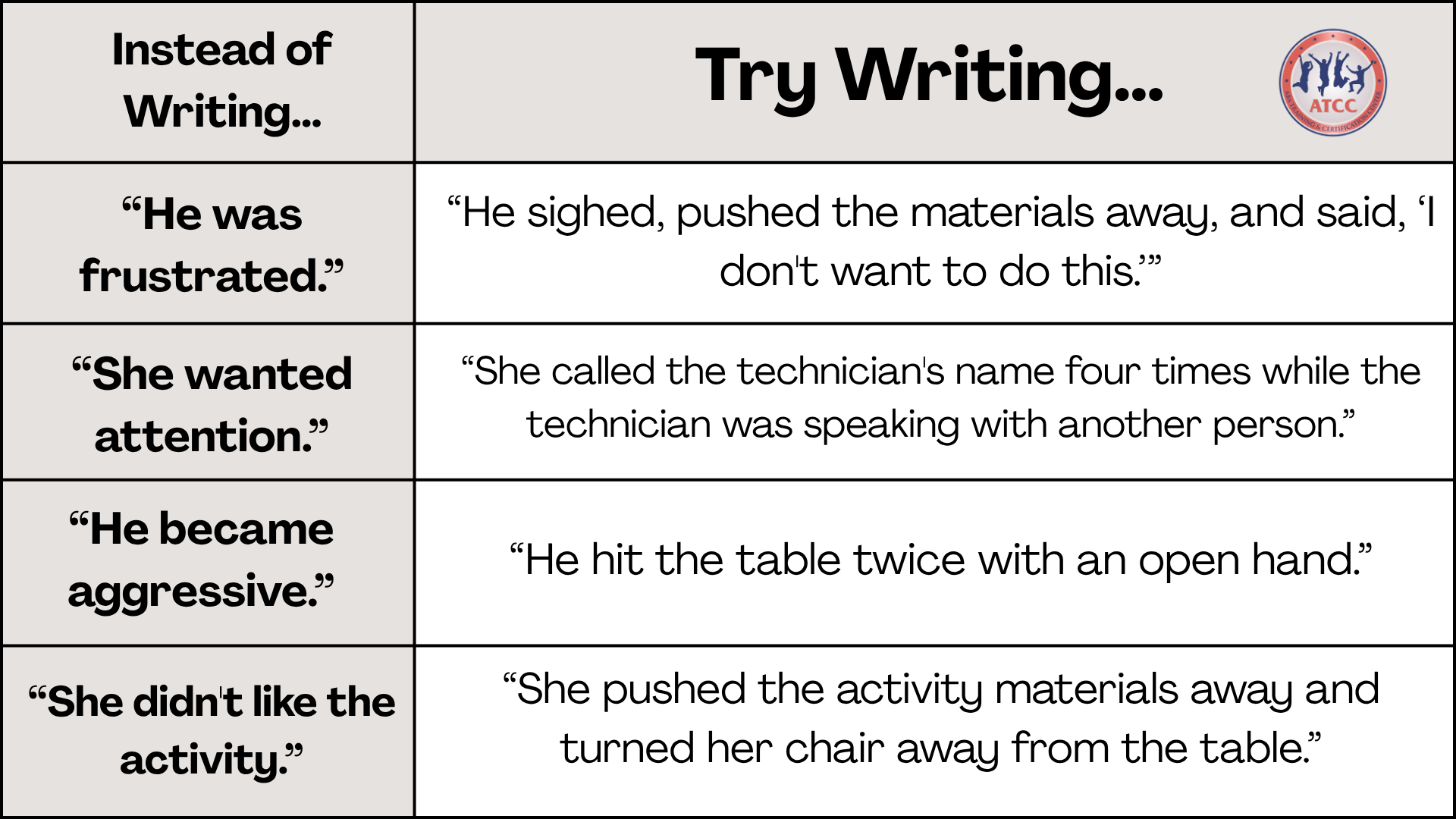
The second column gives the team information they can actually observe and evaluate. That difference may seem small, but it can make your data much more useful.
5 Common ABC Data Collection Mistakes
Even when you understand A-B-C, real-life sessions move quickly.
These are a few mistakes new RBTs should watch for:
These are a few mistakes new RBTs should watch for:
1. Using opinions instead of observations.
Write what you saw and heard rather than what you believe the client was thinking or feeling.
2. Making the behavior description too vague.
“Had a tantrum” provides much less information than describing exactly what occurred.
3. Skipping details about what happened immediately before the behavior.
The antecedent is an important part of the observation.
4. Confusing “consequence” with punishment.
Remember that a consequence simply means what happened after the behavior.
5. Trying to determine the function from one ABC entry.
A single observation may provide useful information, but behavior analysts typically look for patterns across observations and other assessment information before drawing conclusions.
Write what you saw and heard rather than what you believe the client was thinking or feeling.
2. Making the behavior description too vague.
“Had a tantrum” provides much less information than describing exactly what occurred.
3. Skipping details about what happened immediately before the behavior.
The antecedent is an important part of the observation.
4. Confusing “consequence” with punishment.
Remember that a consequence simply means what happened after the behavior.
5. Trying to determine the function from one ABC entry.
A single observation may provide useful information, but behavior analysts typically look for patterns across observations and other assessment information before drawing conclusions.
Practice ABC Data Collection with ATCC
Understanding ABC data is one thing. Practicing it is what helps the skill start to feel natural.
ATCC created a FREE ABC Data Collection Starter Pack to help aspiring and current RBTs practice identifying antecedents, behaviors, and consequences.
The pack includes a printable ABC Data Collection Sheet, a completed example, an Objective vs. Subjective Language Guide, practice scenarios, and an ABC Quick Reference Guide.
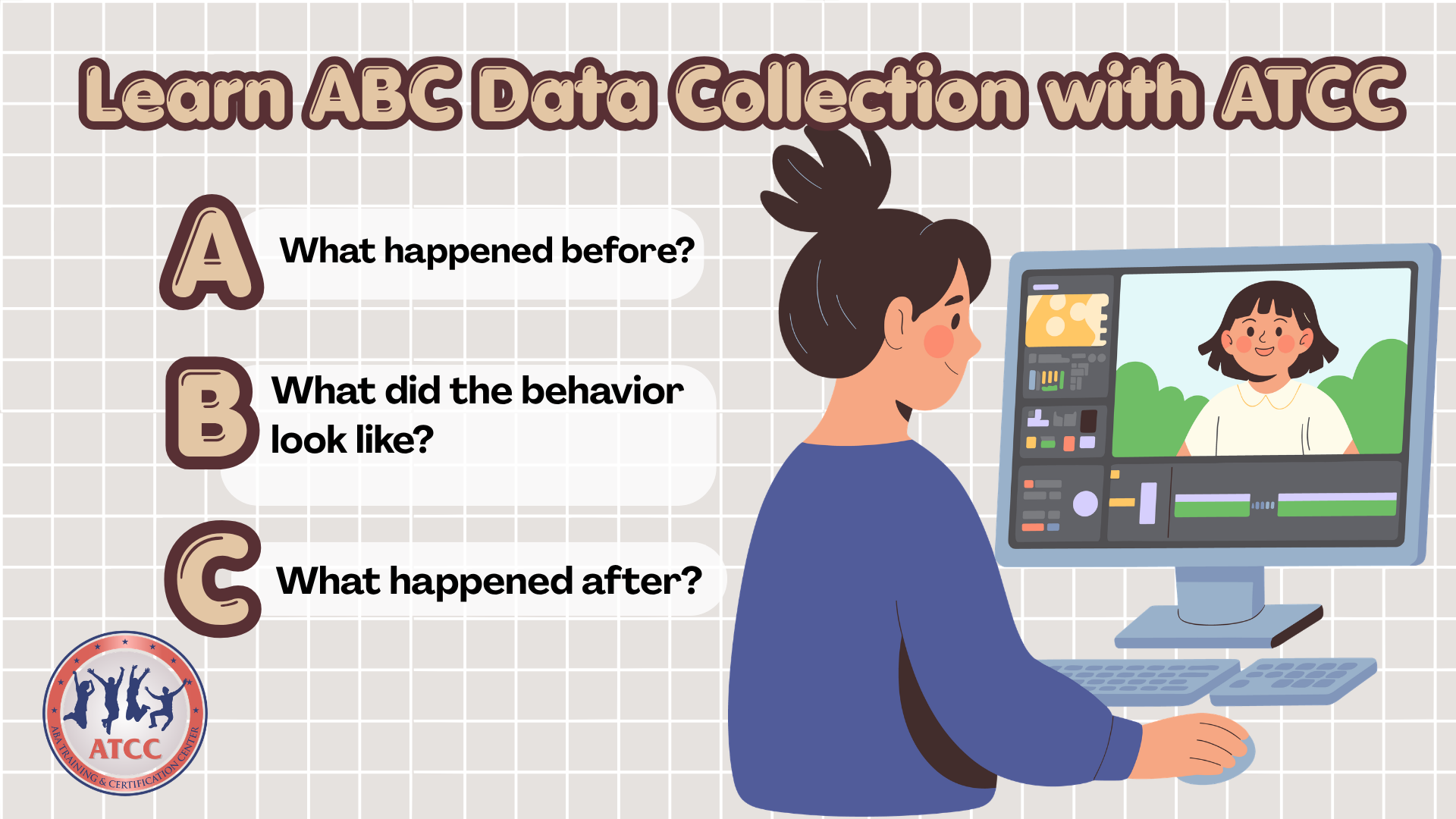
As you practice, remember the three questions:
What happened before?
What did the behavior look like?
What happened after?
The more you practice observing and writing objectively, the easier ABC data collection becomes.
If you are beginning your RBT journey, ATCC provides training and certification support designed to help you understand the skills you’ll use in the field and move through the certification process with confidence.
ATCC created a FREE ABC Data Collection Starter Pack to help aspiring and current RBTs practice identifying antecedents, behaviors, and consequences.
The pack includes a printable ABC Data Collection Sheet, a completed example, an Objective vs. Subjective Language Guide, practice scenarios, and an ABC Quick Reference Guide.
As you practice, remember the three questions:
What happened before?
What did the behavior look like?
What happened after?
The more you practice observing and writing objectively, the easier ABC data collection becomes.
If you are beginning your RBT journey, ATCC provides training and certification support designed to help you understand the skills you’ll use in the field and move through the certification process with confidence.
Keep Learning with ATCC®
Want to see how these concepts connect to RBT® training?
This sneak peek from ATCC’s 2026 40-Hour RBT® Training introduces stimuli, responses, and the three-term contingency, including the relationship between antecedents, behaviors, and consequences.
Through clear explanations and practical ABA examples, future RBTs® can see how the ABC model is used to understand what happens before a behavior, what the behavior looks like, and what happens afterward.
Watch the sneak peek from Chapter 2: Stimuli, Responses, and the 3-Term Contingency and get a preview of how ATCC teaches important ABA concepts throughout the 2026 RBT® Training.
This sneak peek from ATCC’s 2026 40-Hour RBT® Training introduces stimuli, responses, and the three-term contingency, including the relationship between antecedents, behaviors, and consequences.
Through clear explanations and practical ABA examples, future RBTs® can see how the ABC model is used to understand what happens before a behavior, what the behavior looks like, and what happens afterward.
Watch the sneak peek from Chapter 2: Stimuli, Responses, and the 3-Term Contingency and get a preview of how ATCC teaches important ABA concepts throughout the 2026 RBT® Training.
Guaranteed Security using one of the most advanced encrypted systems on the market.
The information in this page is being processed and encrypted securely using industry-leading encryption and fraud prevention tools.

ATCC’s mission is to make ABA certifications, strategies, and therapy for children with autism accessible to everyone. We offer comprehensive ABA training—including the RBT® 2026 40‑Hour Training Requirements and the RBT® Test Content Outline (3rd ed.)—alongside the RBT® Competency Assessment, Full RBT® Certification Program, Rapid RBT® Exam Prep, AB-1172 School Behavioral Training, Parent & Caregiver Training, and Remote BCBA® Supervision for graduate students, all designed to empower those working with children diagnosed with Autism Spectrum Disorder (ASD).
1-877-770-2822
SUPPORT@ATCCONLINE.COM
AFFILIATE PROGRAM
CONTACT US
1-877-770-2822
SUPPORT@ATCCONLINE.COM
AFFILIATE PROGRAM
CONTACT US