RBT® Training Options
Write your awesome label here.
✅ 87.2% first-time pass rate on the RBT® board examination!
📚 4 study resources, $1,196 value — now free upon completion of the ATCC® 40-hour RBT Training course.
💬 AI-powered practice support!
💬 AI-powered practice support!
Starting your RBT® journey can feel exciting, but it can also bring up a lot of questions.
Future Registered Behavior Technicians often ask:
- What is an RBT®?
- How do I become certified?
- What happens after the 40-hour training?
- What is the Competency Assessment?
- What should I review before the exam?
The good news is that the Behavior Analyst Certification Board, or BACB®, provides official resources that can help future RBTs® understand the process more clearly.
If you are planning to become an RBT®, here are five helpful BACB® resources to review as you begin your journey.
If you are planning to become an RBT®, here are five helpful BACB® resources to review as you begin your journey.
Write your awesome label here.
1. The “What Is an RBT®?” Resource
One helpful place to start is the BACB® resource explaining what an RBT® is and how the certification is used.
This is especially helpful for students who are new to ABA therapy and want to understand the role before choosing a training option. RBTs® are paraprofessionals in behavior analysis. They help deliver behavior-analytic services and work under the direction and close supervision of a qualified supervisor.
This resource can help future RBTs® understand that the role is not only about working with clients. It also involves following treatment plans, collecting data, using professional communication, protecting client dignity, and working under supervision.
Before starting training, it is helpful to understand what the RBT® role actually looks like in the field.
This is especially helpful for students who are new to ABA therapy and want to understand the role before choosing a training option. RBTs® are paraprofessionals in behavior analysis. They help deliver behavior-analytic services and work under the direction and close supervision of a qualified supervisor.
This resource can help future RBTs® understand that the role is not only about working with clients. It also involves following treatment plans, collecting data, using professional communication, protecting client dignity, and working under supervision.
Before starting training, it is helpful to understand what the RBT® role actually looks like in the field.
2. The “How to Become an RBT®” Resource
Many future RBTs® know they need the 40-hour training, but they may not realize that training is only one part of the certification process.
The BACB® provides a resource that explains the general steps to becoming an RBT®, including eligibility requirements, application steps, examination information, and other important parts of the process.
This resource is helpful because it gives future RBTs® a bigger-picture view of the journey.
The BACB® provides a resource that explains the general steps to becoming an RBT®, including eligibility requirements, application steps, examination information, and other important parts of the process.
This resource is helpful because it gives future RBTs® a bigger-picture view of the journey.
The process may include:
- Meeting eligibility requirements
- Completing the required 40-hour RBT® training
- Completing the Initial Competency Assessment
- Submitting the BACB® application
- Taking and passing the RBT® exam
- Meeting ongoing supervision and maintenance requirements after certification
- Understanding these steps early can help students avoid confusion and choose the level of training support that fits their needs.
3. The RBT® Handbook
The RBT® Handbook is one of the most important written resources for future RBTs®.
It provides official information about obtaining and maintaining RBT® certification. It also explains important details about eligibility, training, the Initial Competency Assessment, applying, examination information, supervision, ethics, and renewal.
Future RBTs® should treat the handbook as a main reference because requirements and procedures can change over time.
It provides official information about obtaining and maintaining RBT® certification. It also explains important details about eligibility, training, the Initial Competency Assessment, applying, examination information, supervision, ethics, and renewal.
Future RBTs® should treat the handbook as a main reference because requirements and procedures can change over time.
The handbook can help answer questions such as:
If you are serious about becoming an RBT®, reviewing the handbook is an important step.
- What are the eligibility requirements?
- What does the 40-hour training requirement involve?
- When does the Initial Competency Assessment happen?
- What should applicants know before submitting an application?
- What happens after certification?
- What is required to maintain RBT® certification?
If you are serious about becoming an RBT®, reviewing the handbook is an important step.
4. The 40-Hour Training Requirements and Competency Assessment Resources
Future RBTs® should understand both the 40-hour training requirement and the Initial Competency Assessment.
The 40-hour training helps students learn foundational ABA concepts, including measurement, assessment, skill acquisition, behavior reduction, documentation, ethics, and professional conduct.
The BACB® also provides training requirements and competency assessment resources that help clarify what future RBTs® need to know.
One important detail is that the 40-hour training must follow a required timeline. It must be completed in no less than 5 days and no more than 180 days.
The Initial Competency Assessment is a separate step that happens after the required training. It allows a qualified assessor to evaluate whether the future RBT® can demonstrate required skills.
This is important because completing the 40-hour training does not automatically mean someone is certified.
The 40-hour training helps students learn foundational ABA concepts, including measurement, assessment, skill acquisition, behavior reduction, documentation, ethics, and professional conduct.
The BACB® also provides training requirements and competency assessment resources that help clarify what future RBTs® need to know.
One important detail is that the 40-hour training must follow a required timeline. It must be completed in no less than 5 days and no more than 180 days.
The Initial Competency Assessment is a separate step that happens after the required training. It allows a qualified assessor to evaluate whether the future RBT® can demonstrate required skills.
This is important because completing the 40-hour training does not automatically mean someone is certified.
Future RBTs® should understand the difference between:
Knowing this difference can prevent delays and confusion later.
- Completing the 40-hour training
- Demonstrating skills during the Initial Competency Assessment
- Applying for certification
- Taking the RBT® exam
Knowing this difference can prevent delays and confusion later.
5. The RBT® Test Content Outline and Exam Resources
The RBT® exam is based on specific content areas, so future RBTs® should become familiar with the RBT® Test Content Outline.
The Test Content Outline helps students understand the areas that may appear on the exam. These areas are connected to the knowledge and skills future RBTs® should learn during training.
The Test Content Outline helps students understand the areas that may appear on the exam. These areas are connected to the knowledge and skills future RBTs® should learn during training.
Exam-related resources can help students review areas such as:
This is why RBT® exam preparation should not only be about memorizing definitions. Future RBTs® should understand how ABA concepts may apply in real situations.
Reviewing exam resources after training can help students feel more organized and prepared for the next step.
- Measurement and data collection
- Assessment
- Skill acquisition
- Behavior reduction
- Documentation and reporting
- Ethics and professional conduct
This is why RBT® exam preparation should not only be about memorizing definitions. Future RBTs® should understand how ABA concepts may apply in real situations.
Reviewing exam resources after training can help students feel more organized and prepared for the next step.
How ATCC Helps Future RBTs® Understand the Process
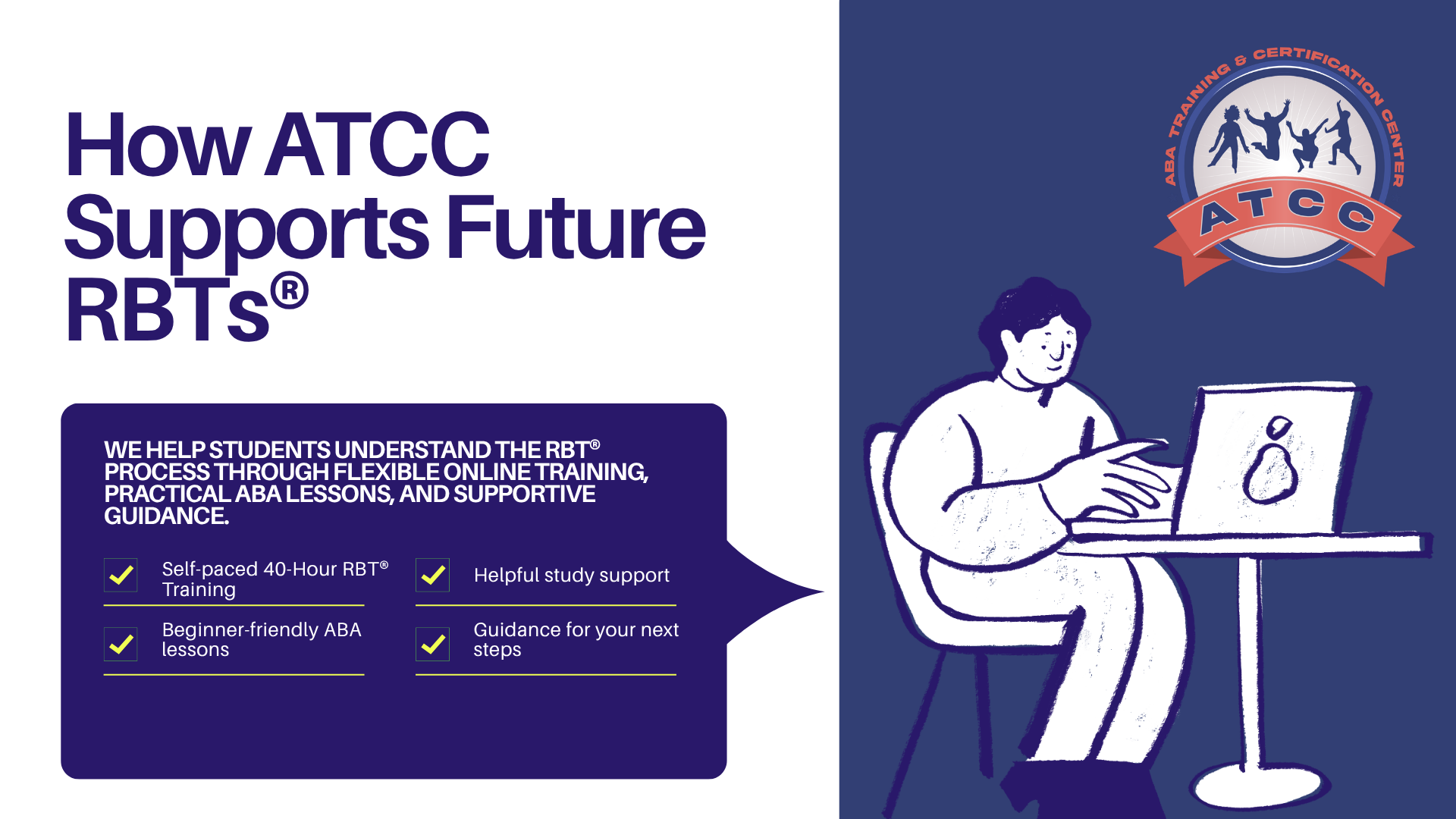
ABA Training and Certification Center, or ATCC, helps future RBTs® learn the foundations of Applied Behavior Analysis through flexible online RBT® training options.
ATCC’s 40-Hour RBT® Training Course is designed for students who need to complete the required training in a self-paced online format. For students who want more guidance, ATCC also offers a more supported RBT® certification pathway that helps students better understand important next steps in the process.
The goal is to help future behavior technicians feel more informed, more prepared, and more confident as they begin their RBT® journey.
ATCC’s 40-Hour RBT® Training Course is designed for students who need to complete the required training in a self-paced online format. For students who want more guidance, ATCC also offers a more supported RBT® certification pathway that helps students better understand important next steps in the process.
The goal is to help future behavior technicians feel more informed, more prepared, and more confident as they begin their RBT® journey.
Keep Learning with ATCC®
This sneak peek video gives future RBTs® a quick look at why official BACB® resources are important before starting the certification process.
It helps students understand that becoming an RBT® involves more than completing the 40-hour training. Future RBTs® should also know about the Initial Competency Assessment, BACB® application, RBT® exam, and ongoing certification requirements.
ATCC’s 2026 40-Hour RBT® Training helps students build a stronger ABA foundation while learning what to expect in their RBT® journey.
It helps students understand that becoming an RBT® involves more than completing the 40-hour training. Future RBTs® should also know about the Initial Competency Assessment, BACB® application, RBT® exam, and ongoing certification requirements.
ATCC’s 2026 40-Hour RBT® Training helps students build a stronger ABA foundation while learning what to expect in their RBT® journey.
Guaranteed Security using one of the most advanced encrypted systems on the market.
The information in this page is being processed and encrypted securely using industry-leading encryption and fraud prevention tools.