RBT® Training Options
✅ 87.2% first-time pass rate on the RBT® board examination!
💬 AI-powered practice support, built into every lesson!
If you are getting started in ABA, one of the biggest surprises is this: being a great RBT® is not just about knowing what to do during a session. It is also about knowing how to track progress clearly and correctly. That is where data comes in. In Chapter 15 of the all-new ATCC® 2026 RBT® Training, students get a practical introduction to how RBT®s calculate and summarize data using rate, mean duration, percentage correct, and trials-to-criterion. This chapter is tied to the RBT® Test Content Outline (3rd ed.) item A.6, which focuses on calculating and summarizing data in different ways.
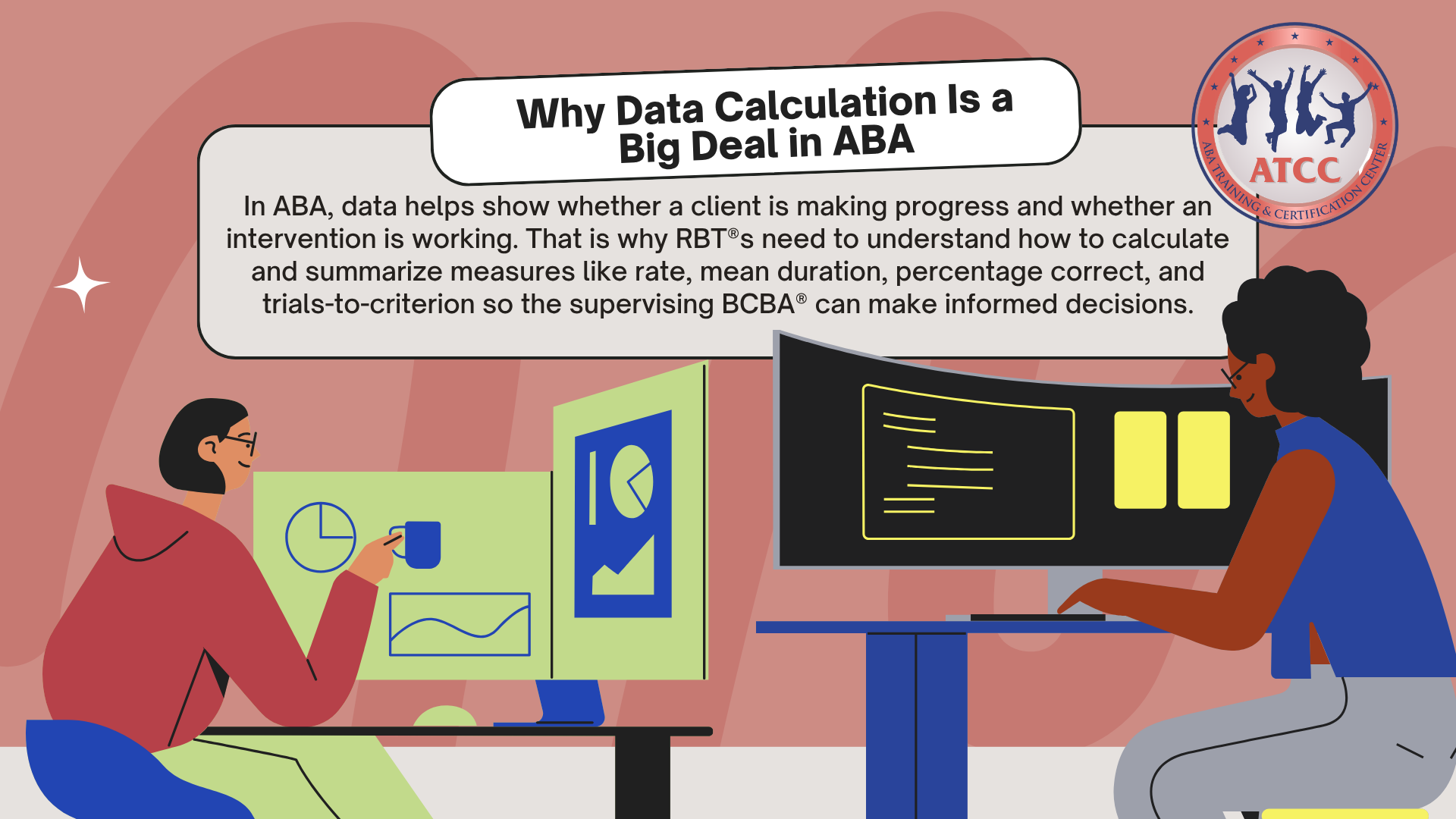
In ABA, progress is not based on guessing. It is based on what the data shows. That means RBT®s need to do more than collect numbers during a session. They also need to understand what those numbers mean and how to summarize them in a way that helps the supervising BCBA® make informed decisions.
This is why learning how to calculate and summarize data matters so much. When an RBT® knows how to calculate a behavior’s rate, average duration, or percentage of correct responses, the data becomes more useful. It tells a clearer story. It can show whether a client is improving, whether an intervention is working, or whether something needs to change. The Chapter 15 preview specifically highlights rate, mean duration, percentage correct, and trials-to-criterion as core ways RBT®s learn to summarize ABA data.
Key Data Measures Every RBT® Should Know
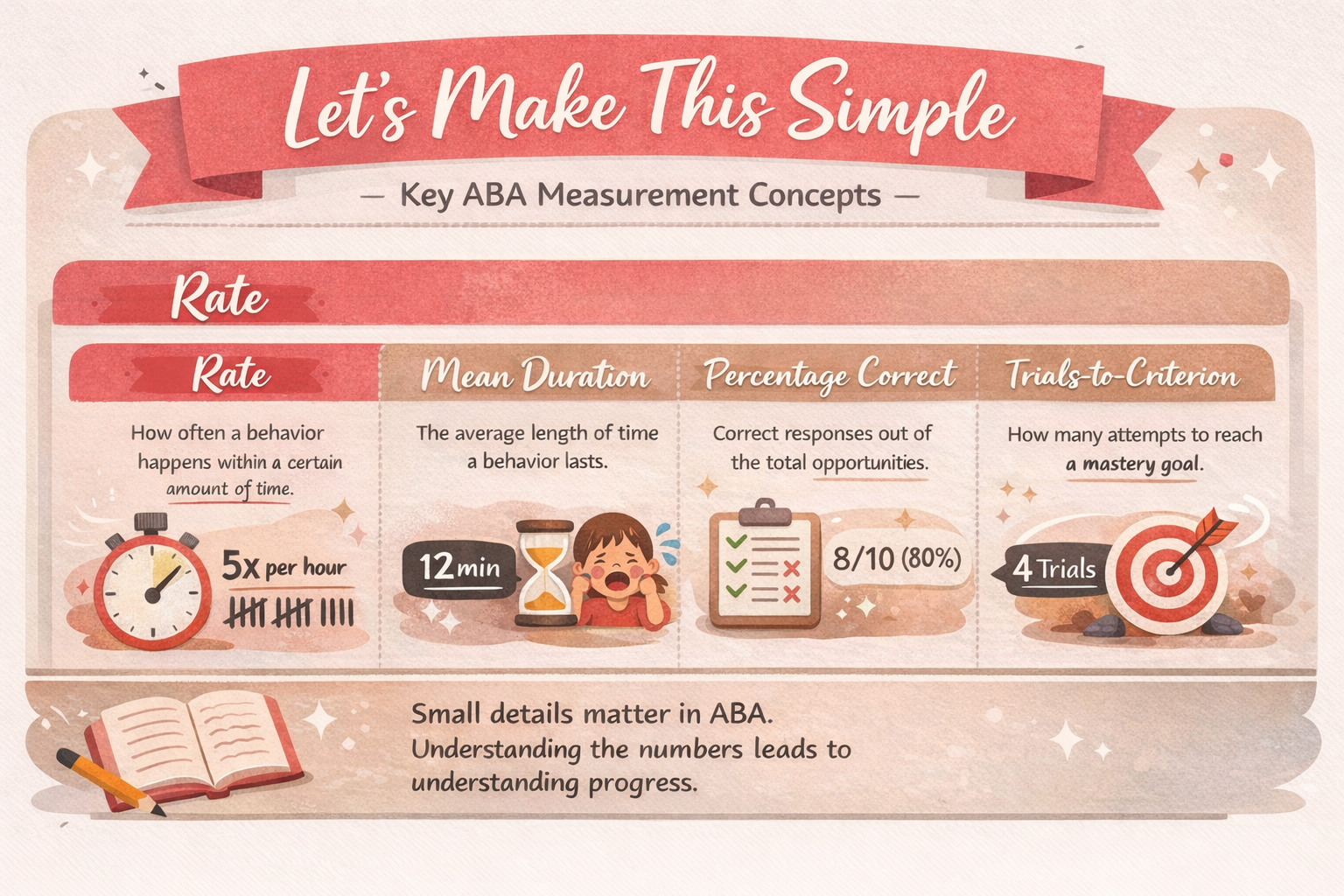
Let’s make this simple.
Rate
Rate looks at how often a behavior happens within a certain amount of time. This helps RBT®s understand how frequently a behavior is occurring in a way that is easier to compare across sessions.
Mean Duration
Mean duration looks at the average length of time a behavior lasts. This is especially helpful when tracking behaviors or skills that have a time component, such as how long a tantrum lasts or how long a client stays engaged in a task.
Percentage Correct
Percentage correct shows how many responses were correct out of the total number of opportunities. This is commonly used when measuring learning targets and skill acquisition.
Trials-to-Criterion
Trials-to-criterion looks at how many teaching opportunities it takes before a learner reaches a pre-set mastery goal. This can help show how efficiently a skill is being learned.
These may sound like small details, but in ABA, small details matter. The better you understand the numbers, the better you understand the learner’s progress. The ATCC® Chapter 15 preview centers on these exact measures to help future RBT®s build confidence with practical data calculation.
Why This Chapter Helps RBT® Students Feel More Confident
One reason students struggle with data is not because the concepts are impossible. It is because the material is often explained in a way that feels too abstract. A lot of people do not need more complicated definitions. They need examples, simple explanations, and a clear reason why the information matters.
That is what makes this kind of lesson so important. Chapter 15 does not just throw formulas at students. It connects data calculation to the real work of an RBT®. It helps students understand that calculating data is not busywork. It is part of how teams track meaningful progress, communicate clearly, and support treatment decisions with accuracy. The sneak peek frames these calculation skills as essential for progress tracking, treatment decisions, and RBT® exam prep.
At ABA Training and Certification Center (ATCC®), the goal is not just to help students finish a course. The goal is to help them actually understand what they are learning.
The ATCC® 2026 40-hour RBT® training is built around updated content, structured learning, and exam-focused support. According to the course page, students who complete the 40-hour training unlock a free RBT® Exam Prep Bundle described as a $1,000+ value. With an 87.2% first-time exam pass rate compared to the 73% average, ATCC® helps students prepare with confidence.
That kind of support matters, especially for students who want training that feels clear, manageable, and connected to real exam success. Our 2026 training includes updated content, 3rd edition alignment, interactive activities, and AI-powered study support to help learners move through the program with confidence.
Keep Learning with ATCC®
If you are looking for a training program that feels organized, beginner-friendly, and aligned with the latest RBT® expectations, explore the ATCC® 2026 40-Hour RBT® Training – 3rd Ed. In our 2026 training, we include updated content, 3rd edition alignment, flexible subscription options, and added exam prep support for students who complete the training.training.
Start learning with ABA Training and Certification Center (ATCC®) and build the kind of confidence that helps data make sense — and helps your RBT® journey feel a lot more doable.
ATCC® – Learn Clearly. Grow Confidently.