Artificial intelligence is changing the workplace, but it cannot replace the hands-on care and human connection at the heart of an RBT®’s work.
Registered Behavior Technicians help real people build meaningful skills through direct instruction, encouragement, and individualized support. Their work requires being present with a learner, building trust, and responding to what happens in each session while following a supervisor-developed treatment plan.
AI can help professionals organize information and complete certain tasks. But those capabilities do not replace the person providing care. Here’s why the human role remains essential—and what that means for your future as an RBT®.
WATCH: Why AI Cannot Replace the Human Role of an RBT®
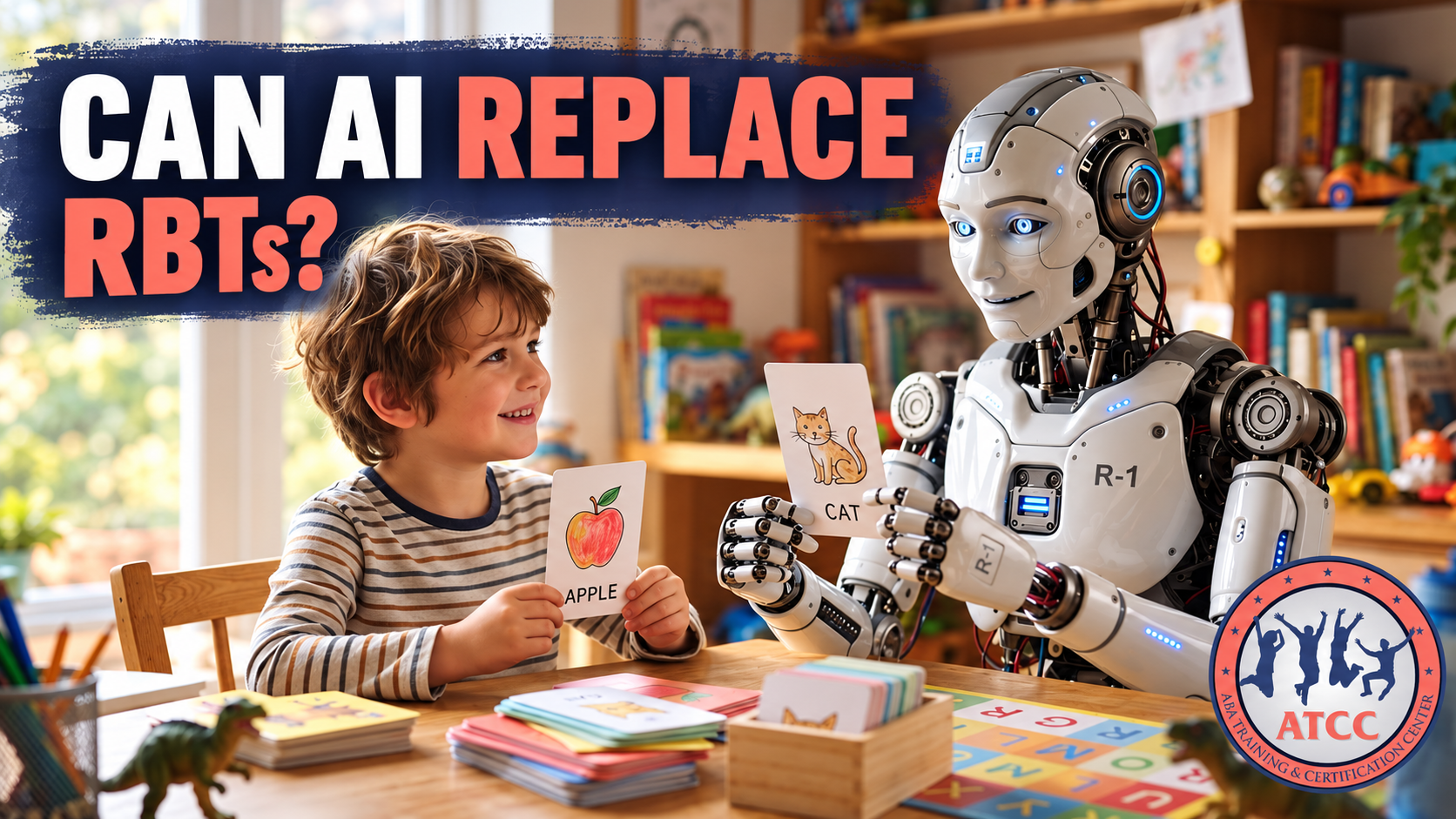
Can AI or SI replace RBTs?
No—AI can support certain tasks, but it cannot replace the hands-on teaching and human connection at the heart of an RBT®’s work.
Registered Behavior Technicians build trusting relationships and provide individualized support under the direction and close supervision of qualified professionals, typically Board Certified Behavior Analysts (BCBAs).
RBT®s help clients practice and develop important everyday skills, such as:
RBT®s help clients practice and develop important everyday skills, such as:
- Communicating needs and preferences
- Following instructions and completing routines
- Developing social and play skills
- Building independence with daily activities
- Learning appropriate replacement behaviors
These skills are often taught through individualized instruction, reinforcement, practice, and carefully collected behavioral data.
But successful teaching isn't simply about knowing what to teach. It's also about understanding how a person responds during the learning process.
That's where human interaction becomes essential.
1. Real-Time Interactions Require Human Responsiveness
Imagine an RBT working with a child who is learning to request a favorite toy.
During one session, the child may respond quickly. During another, the child may need additional prompting or opportunities to practice.
The RBT observes what happens, follows the established teaching procedures, delivers reinforcement as specified, and records the child's responses.
Technology can help organize the data collected during these interactions. However, providing individualized instruction in a changing real-world environment also requires practical skills, close observation, and appropriate professional judgment within the RBT's scope of practice.
AI can process information, but that is not the same as delivering hands-on instruction to a learner.
2. Building Rapport Is Part of Effective Teaching
Consider a child who is meeting a new RBT for the first time.
Before introducing more challenging learning activities, the RBT may spend time participating in preferred activities, discovering the child's interests, and establishing positive interactions.
This process helps the RBT develop rapport and become associated with enjoyable experiences.
Over time, positive interactions can support cooperation and engagement during teaching sessions.
AI tools may generate activity suggestions, but they cannot fully replicate the experience of participating in a shared activity, responding naturally to a learner, and developing a professional relationship through repeated interactions.
3. Many Everyday Skills Need Hands-On Practice
Some skills are best learned through practice in the environments where they will actually be used.
For example, teaching a child to put on a jacket may involve breaking the task into smaller steps, demonstrating the skill, providing appropriate prompts, and gradually reducing assistance.
An RBT might help the learner practice:
For example, teaching a child to put on a jacket may involve breaking the task into smaller steps, demonstrating the skill, providing appropriate prompts, and gradually reducing assistance.
An RBT might help the learner practice:
- Identifying the correct way to hold the jacket
- Placing one arm into a sleeve
- Placing the other arm into the second sleeve
- Adjusting the jacket independently
The RBT follows the supervisor-developed treatment plan and measures progress throughout instruction.
AI might help a qualified professional organize a task analysis, but it does not replace the practical support needed when a learner is practicing a physical skill.
AI might help a qualified professional organize a task analysis, but it does not replace the practical support needed when a learner is practicing a physical skill.
4. Every Learner Is Different
Helping with a task is different from replacing the professional who delivers care. AI may support certain administrative and analytical activities, while RBT®s provide the direct teaching, hands-on assistance, and human interaction that clients need.
Examples of potential supporting uses include:
Examples of potential supporting uses include:
5. AI Can Support RBTs—But Cannot Take Their Place
Being relatively resistant to automation does not mean an RBT's work will remain unchanged.
AI and other digital technologies may increasingly support administrative and analytical tasks, including:
AI and other digital technologies may increasingly support administrative and analytical tasks, including:
- Organizing nonconfidential training resources
- Supporting data visualization
- Helping authorized professionals identify patterns in data
- Assisting with administrative workflows
- Supporting the development of educational materials
However, these tools also introduce important considerations involving accuracy, privacy, professional responsibility, and client confidentiality.
The Behavior Analyst Certification Board (BACB) has discussed the potential benefits and risks of AI in ABA practice, emphasizing the importance of complying with professional ethics requirements and applicable laws.
Technology should support responsible clinical practice, not replace professional supervision, individualized care, or ethical decision-making.
Why RBTs Remain Essential in an AI-Powered World
As technology advances, the hands-on support and human relationships at the heart of an RBT®’s work remain essential. Choosing this career means developing skills that go beyond processing information: helping people learn, building trust, and supporting meaningful progress in everyday life.
Ready to build a career where your human connection makes a difference? Explore our Full RBT® Certification Program today.
Ready to build a career where your human connection makes a difference? Explore our Full RBT® Certification Program today.
Interested in Becoming an RBT?
Build a career where your ability to connect with people makes a difference. ATCC® helps you take the next step toward becoming an RBT®.
Choose our 40-Hour RBT® Training Course if you plan to complete the remaining certification steps with an employer.
For more comprehensive support, our Full RBT® Certification Program includes the 40-hour training, BCBA® support, Initial Competency Assessment, exam preparation, application assistance, and covered BACB® application and Pearson VUE exam fees.
Explore RBT® Training and Certification at ATCC.
Guaranteed Security using one of the most advanced encrypted systems on the market.
The information in this page is being processed and encrypted securely using industry-leading encryption and fraud prevention tools.
Reviews and Testimonials
Meet Catia
Meet Catia, an ATCC alumni success story who is now an RBT®. In her testimonial, Catia shares her experience with ATCC and how the training and support helped her move forward in her RBT® journey. Her story gives future RBTs® a real look at how clear guidance, encouragement, and preparation can make the process feel more achievable.
Meet Maeonna
Meet Maeonna, an ATCC alumni who is now putting her training into practice in the field. Her story shows how the right support and preparation can help future RBTs® build confidence, grow professionally, and take meaningful steps toward success in their ABA career.
These stories matter because becoming an RBT® is not just about completing a course. It is about building confidence, understanding ABA concepts, and preparing for a professional role that requires compassion, responsibility, and strong foundational training.
ATCC’s mission is to make ABA certifications, strategies, and therapy for children with autism accessible to everyone. We offer comprehensive ABA training—including the RBT® 2026 40‑Hour Training Requirements and the RBT® Test Content Outline (3rd ed.)—alongside the RBT® Competency Assessment, Full RBT® Certification Program, Rapid RBT® Exam Prep, AB-1172 School Behavioral Training, Parent & Caregiver Training, and Remote BCBA® Supervision for graduate students, all designed to empower those working with children diagnosed with Autism Spectrum Disorder (ASD).
1-877-770-2822
SUPPORT@ATCCONLINE.COM
AFFILIATE PROGRAM
CONTACT US
1-877-770-2822
SUPPORT@ATCCONLINE.COM
AFFILIATE PROGRAM
CONTACT US