RBT® Training Options
Write your awesome label here.
✅ 87.2% first-time pass rate on the RBT® board examination!
📚 4 study resources, $1,196 value — now free upon completion of the ATCC® 40-hour RBT Training course.
💬 AI-powered practice support!
💬 AI-powered practice support!
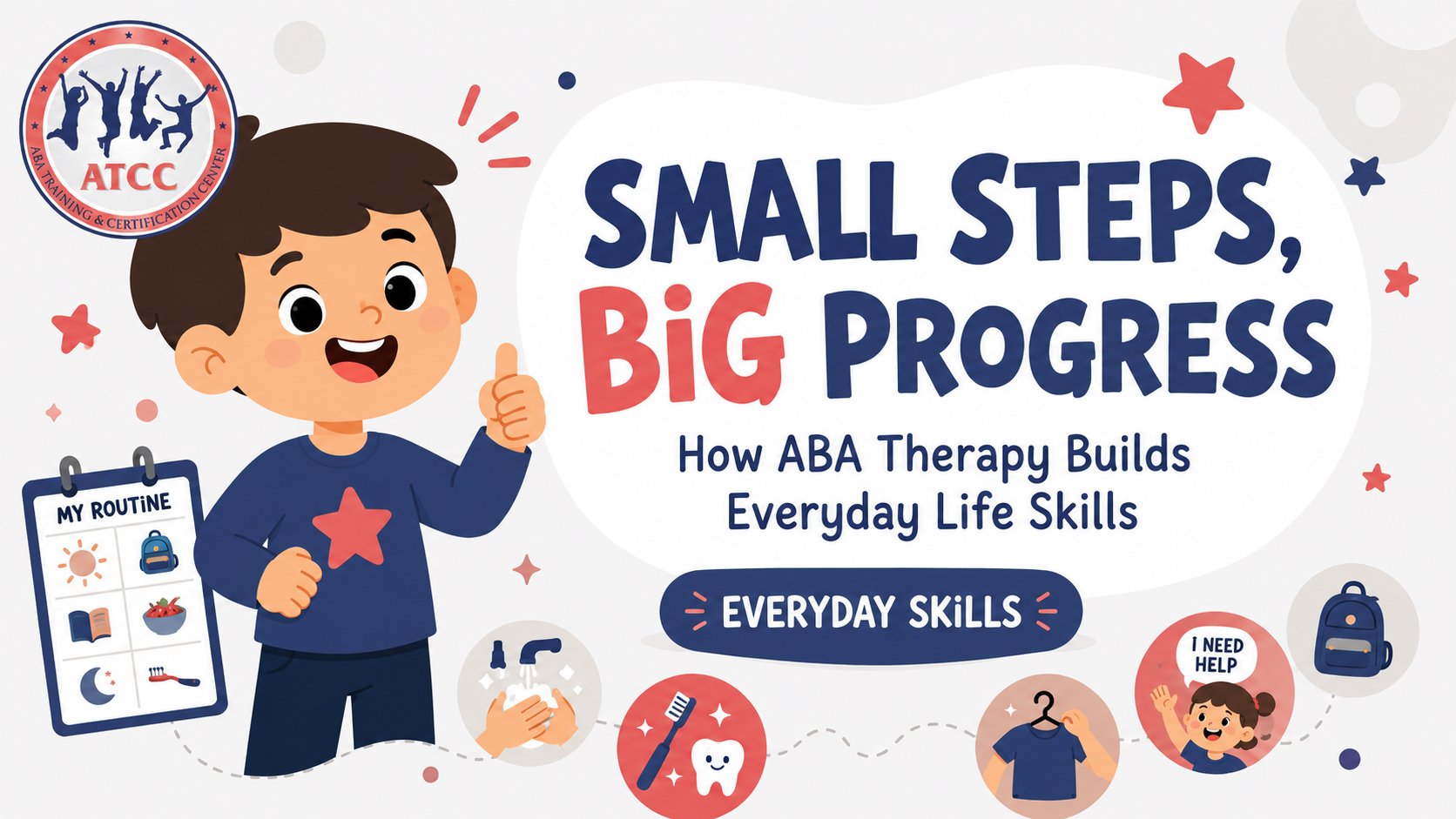
Big progress often begins with a small step.
What Are Everyday Life Skills?
Why ABA Uses Small Steps
How ABA Helps Build Everyday Skills
Reinforcement
Positive reinforcement can help strengthen new skills.When a behavior is followed by something meaningful to the learner and the behavior becomes more likely to happen again, reinforcement has occurred. Reinforcement may include praise, tokens, music, a preferred activity, or another item the client values.
Prompting
Prompts provide support while a client is learning.They may include verbal, visual, gestural, model, or physical assistance. Prompts should be faded over time according to the behavior plan so the client can complete the skill more independently.
Practice in Natural Settings
A skill may need to be practiced with different people and in different environments.For example, a client may learn to request a break during an ABA session and later practice the same skill at school or at home. This helps the skill become more useful in everyday life.
Data Collection
RBTs® collect objective data about client performance. This may include accuracy, frequency, duration, or the amount of prompting required. The supervising BCBA® uses this information to evaluate progress and determine whether teaching strategies need to be adjusted.
Positive reinforcement can help strengthen new skills.When a behavior is followed by something meaningful to the learner and the behavior becomes more likely to happen again, reinforcement has occurred. Reinforcement may include praise, tokens, music, a preferred activity, or another item the client values.
Prompting
Prompts provide support while a client is learning.They may include verbal, visual, gestural, model, or physical assistance. Prompts should be faded over time according to the behavior plan so the client can complete the skill more independently.
Practice in Natural Settings
A skill may need to be practiced with different people and in different environments.For example, a client may learn to request a break during an ABA session and later practice the same skill at school or at home. This helps the skill become more useful in everyday life.
Data Collection
RBTs® collect objective data about client performance. This may include accuracy, frequency, duration, or the amount of prompting required. The supervising BCBA® uses this information to evaluate progress and determine whether teaching strategies need to be adjusted.
What Does Progress Look Like?
Progress does not always mean mastering an entire routine immediately.
It may look like:
These small improvements can lead to meaningful changes over time.
It may look like:
- Completing one additional step independently
- Needing less assistance
- Communicating a need more clearly
- Participating in an activity for longer
- Using a skill with a new person
- Completing a routine in a different setting
These small improvements can lead to meaningful changes over time.
The RBT® Role
RBTs® help clients practice important skills by following treatment plans developed by a supervising BCBA®.
During a session, an RBT® may:
Present instructions
During a session, an RBT® may:
Present instructions
Use approved prompting procedures
Deliver reinforcement
Practice skills in structured and natural settings
Collect accurate data
Deliver reinforcement
Practice skills in structured and natural settings
Collect accurate data
Protect client dignity
Report relevant observations to the supervisor
RBTs® do not independently create or change treatment plans. They work under supervision and follow the procedures provided by the behavior team.
Report relevant observations to the supervisor
RBTs® do not independently create or change treatment plans. They work under supervision and follow the procedures provided by the behavior team.
Start Building the Skills to Become an RBT®
Future RBTs® need a strong understanding of ABA principles, reinforcement, prompting, data collection, ethics, and professional conduct.
ABA Training and Certification Center offers flexible RBT® training options for students interested in learning the foundational skills used in Applied Behavior Analysis.
Students can choose between the self-paced 40-Hour RBT® Training Course and the more guided Full RBT® Certification Program, depending on the level of support they need.
ABA Training and Certification Center offers flexible RBT® training options for students interested in learning the foundational skills used in Applied Behavior Analysis.
Students can choose between the self-paced 40-Hour RBT® Training Course and the more guided Full RBT® Certification Program, depending on the level of support they need.
Small Steps Can Create Meaningful Change
ABA therapy shows that progress does not need to happen all at once.
One new request, one completed step, or one successful transition can represent meaningful growth.
With consistent teaching, individualized support, and careful data collection, small skills can develop into greater independence and improved quality of life.
Ready to begin your RBT® journey?
Explore the training options available through ABA Training and Certification Center.
One new request, one completed step, or one successful transition can represent meaningful growth.
With consistent teaching, individualized support, and careful data collection, small skills can develop into greater independence and improved quality of life.
Ready to begin your RBT® journey?
Explore the training options available through ABA Training and Certification Center.
Keep Learning with ATCC®
The sneak peek into The Role of the RBT® gives future behavior technicians a closer look at how RBTs® support clients during ABA therapy. The video highlights important responsibilities such as following treatment plans, using prompting and reinforcement, collecting accurate data, protecting client dignity, and working under BCBA® supervision.
This practical introduction helps students understand that becoming an RBT® involves more than learning definitions. It means developing the skills, professionalism, and confidence needed to support meaningful client progress.
ATCC’s 2026 40-Hour RBT® Training uses engaging videos and real-world examples to help future RBTs® understand what their role may look like in the field.
ATCC’s 2026 40-Hour RBT® Training uses engaging videos and real-world examples to help future RBTs® understand what their role may look like in the field.
Guaranteed Security using one of the most advanced encrypted systems on the market.
The information in this page is being processed and encrypted securely using industry-leading encryption and fraud prevention tools.
ATCC’s mission is to make ABA certifications, strategies, and therapy for children with autism accessible to everyone. We offer comprehensive ABA training—including the RBT® 2026 40‑Hour Training Requirements and the RBT® Test Content Outline (3rd ed.)—alongside the RBT® Competency Assessment, Full RBT® Certification Program, Rapid RBT® Exam Prep, AB-1172 School Behavioral Training, Parent & Caregiver Training, and Remote BCBA® Supervision for graduate students, all designed to empower those working with children diagnosed with Autism Spectrum Disorder (ASD).
1-877-770-2822
SUPPORT@ATCCONLINE.COM
AFFILIATE PROGRAM
CONTACT US
1-877-770-2822
SUPPORT@ATCCONLINE.COM
AFFILIATE PROGRAM
CONTACT US