Barbie Mendoza, BS, RBT
Jan 28

Say What You See: The RBT® Guide to Observable, Measurable ABA Documentation (2026 TCO A.5)

States
Our students gain RBT® and BCBA® certifications with the Behavior Analyst Certification Board (BACB®) in all 50-states and Canada.

Successful Students
We are proud to have students who are committed to changing the world, delivering compassionate ABA intervention, and building a better future for our children. 

EXAM PASS RATE
For students who complete the ATCC® 40-hour RBT® Training course, 87.2% of ATCC students pass the exam on their first attempt, far above the 73% average pass rate for other providers.

RBT® Training Options

Write your awesome label here.

✅ 87.2% first-time pass rate on the RBT® board examination!

📚 4 study resources, $1,196 value — now free upon completion of the ATCC® 40-hour RBT Training course.
💬 AI-powered practice support! Study smarter with interactive, on-demand guidance from the RBT® Exam Prep AI ChatBot that helps you review, quiz, and reinforce key concepts instantly.
Let’s be real: the hardest part of writing good ABA notes isn’t the typing, it’s resisting the urge to interpret. When you’re in the middle of an RBT® session and a learner is having a tough moment, your brain wants to label it fast: “He’s mad,” “She’s anxious,” “They’re being defiant.” But ATCC 2026 RBT® Training (3rd Ed.), Chapter 11: Describe Behavior in Observable Terms is basically your “no more guessing” upgrade. This chapter lines up with RBT Test Content Outline (3rd ed.) A.5 and trains you to describe behavior, stimuli, and the environment using clear, observable, measurable language—the kind that leads to accurate data and strong clinical decisions.

The “No Guessing” Rule

Objective language is a professional upgrade. When you describe behavior the way a camera would record it, your notes become clearer, your data becomes cleaner, and your supervisor can actually make confident clinical decisions based on what you captured.

The Mind-Reading Trap (and How to Avoid It)

Words like rude, manipulative, lazy, stubborn, attention-seeking, or overstimulated aren’t behaviors—they’re interpretations. The goal is to swap labels for observable actions.
Instead of: “He was aggressive.”
Try: “He hit the table with an open hand 3 times and kicked the chair once.”

Make It Measurable (So It’s Trackable)

“Measurable” means you can collect data with consistency—today, tomorrow, and across technicians.
Common measurement options:

  • Frequency (how many times)
  • Duration (how long it lasts)
  • Latency (how long after an instruction it begins)
  • Intensity (only when clearly defined and trained)


Behavior vs. Environment (Don’t Mix Them Up)

Clean notes separate three things:

  • Behavior:  what the learner did
  • Environment/Stimuli: what was happening around them
  • Context: what happened right before/right after that impacts the data
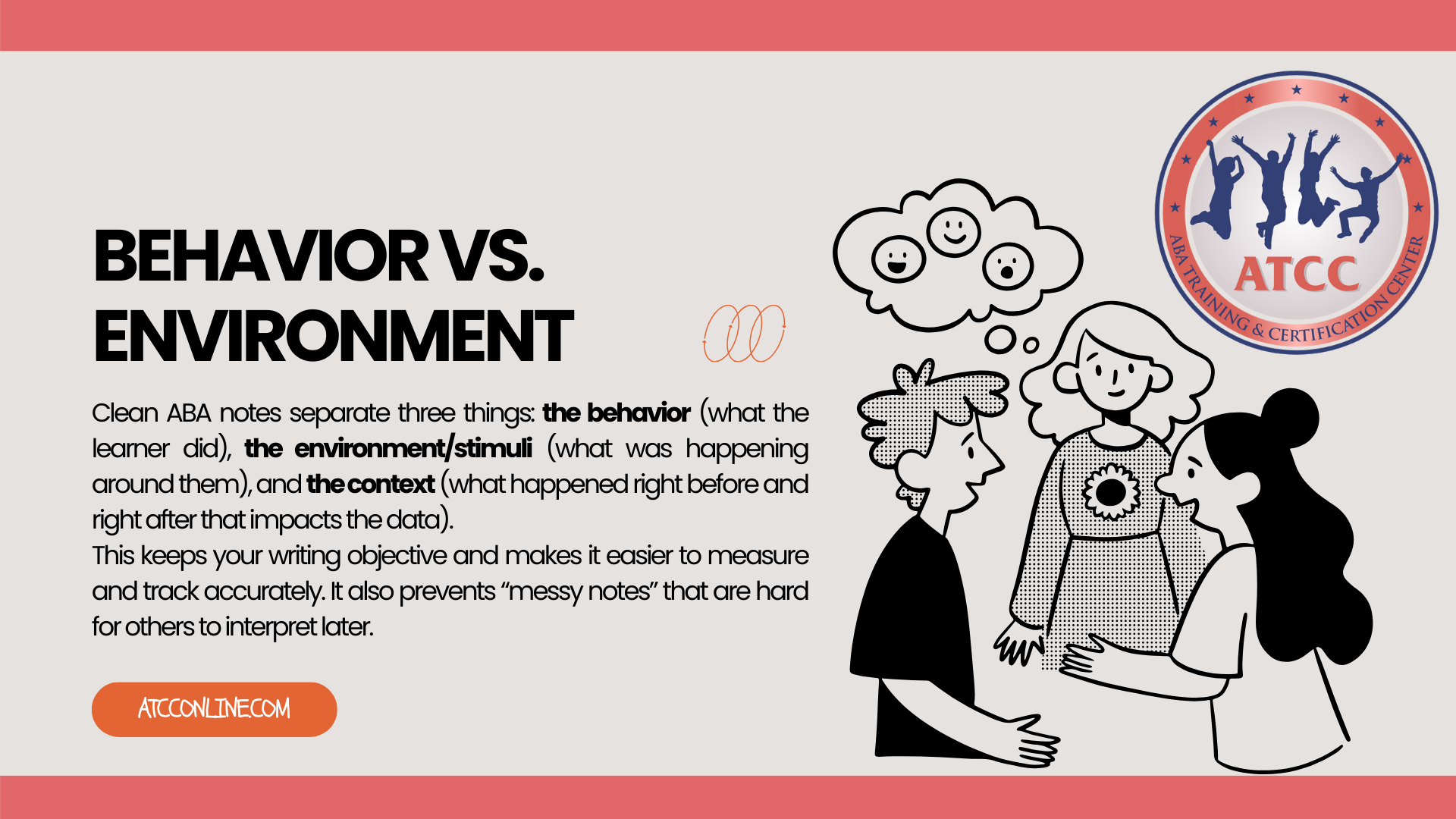
This is how you avoid “messy notes” that can’t be interpreted later.

What “Say What You See” Looks Like

Use descriptions that answer: What did they do? How many times? How long? Under what conditions?

Before: “She refused the task.”

After: “After the instruction ‘put the puzzle away,’ she looked away and did not touch the puzzle pieces for 30 seconds.”
Before: “He was overstimulated.”
After: “During group time with loud music playing, he covered his ears, vocalized ‘stop,’ and moved to the corner for 2 minutes.”
Before: “She was tantruming.”
After: “She dropped to the floor, cried with tears present, and screamed above conversational volume for 1 minute 15 seconds.”


Thank you!

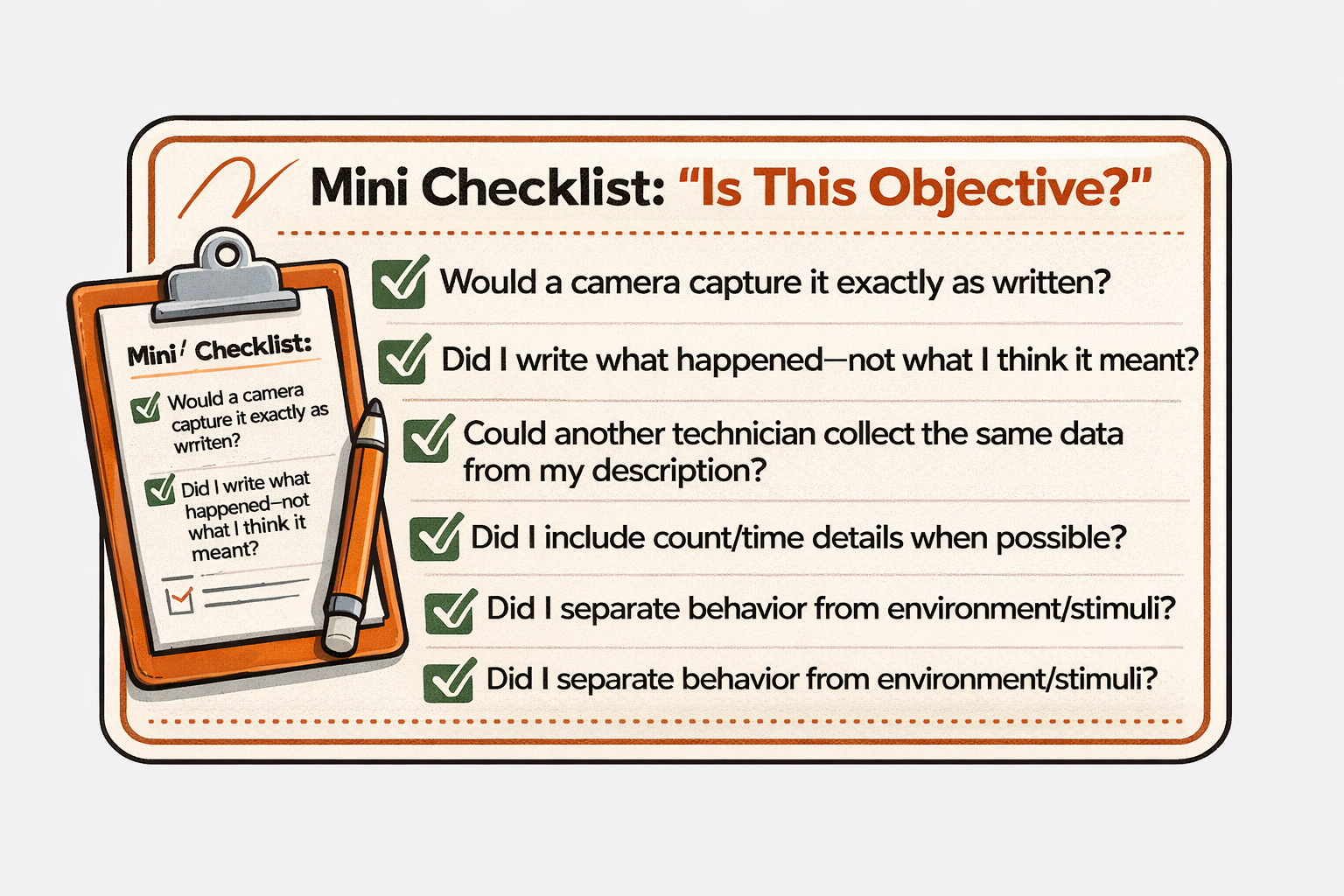
Mini Checklist: “Is This Objective?”

 Would a camera capture it exactly as written?
 Did I write what happened—not what I think it meant?
 Could another technician collect the same data from my description?
 Did I include count/time details when possible?
 Did I separate behavior from environment/stimuli?
Keep Learning with ATCC®

Check out a sneak peek of the all-new ATCC® 2026 RBT® Training (3rd Ed.) featuring the skill every RBT® needs: describing behavior in observable, measurable terms—no guessing, no labels, just clean documentation. This preview aligns with the RBT® Test Content Outline (3rd ed.; TCO): A.5. Describe behavior and environment in observable and measurable terms.

You’ll learn how to separate behavior from environment/stimuli, use objective “camera-ready” language, and add count/time details so your notes support accurate data and confident clinical decisions (plus stronger RBT® exam prep).
Write your awesome label here.

ATCC® — Clear notes. Better data. Stronger ABA.

Guaranteed Security using one of the most advanced encrypted systems on the market.
The information in this page is being processed and encrypted securely using industry-leading encryption and fraud prevention tools.