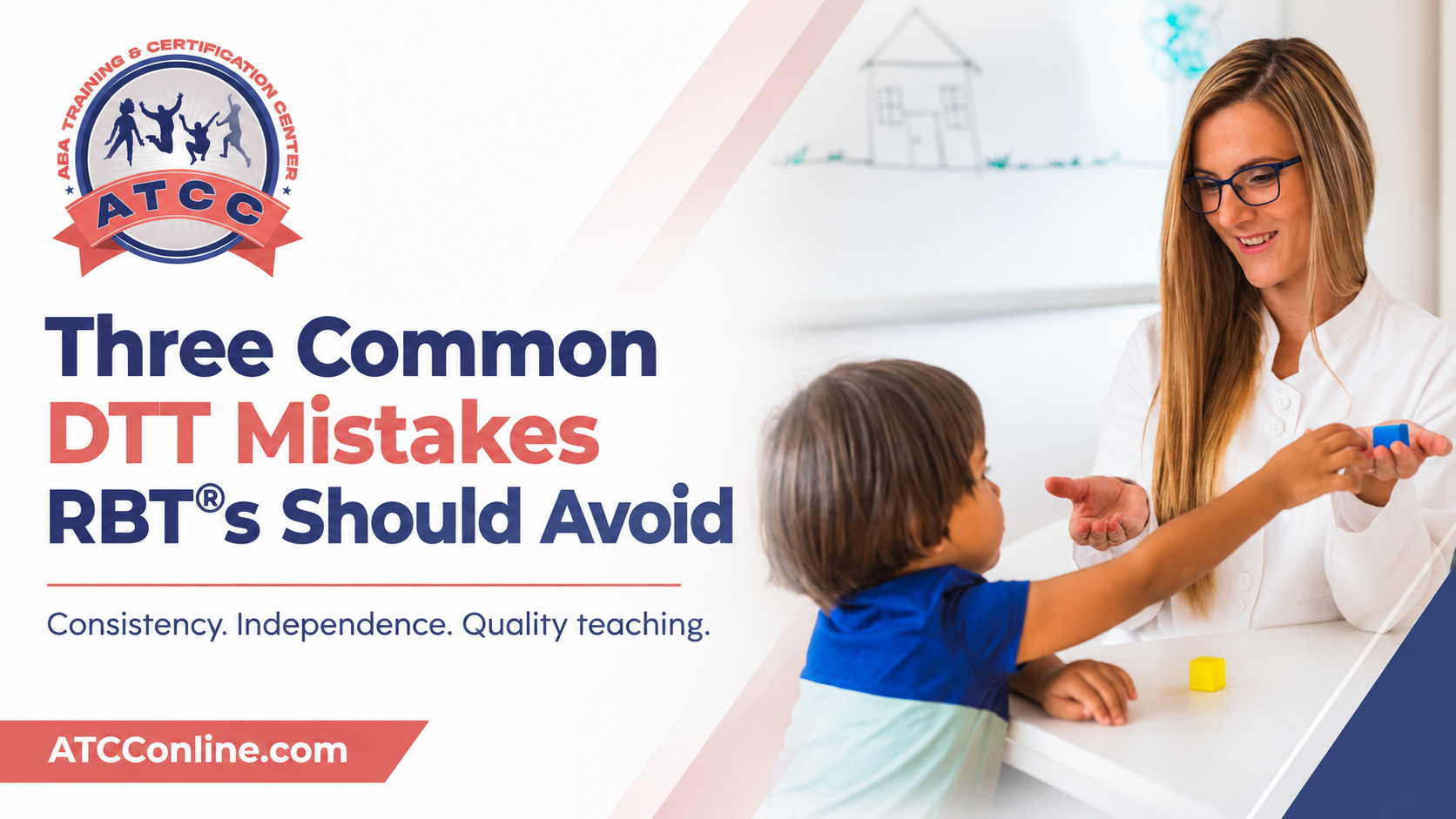
Watch the Video: Three Common DTT Mistakes RBTs Should Avoid
Discrete Trial Training (DTT) is one of the most structured teaching approaches used in Applied Behavior Analysis. Here are three common DTT mistakes RBT®s should watch for.
DTT Mistake #1: Changing the Instruction Too Much
In DTT, the discriminative stimulus, or SD, should be delivered clearly and consistently.
For example, if the program says:
“Touch red.”
the RBT® should avoid changing it from trial to trial with phrases like:
“Can you find red?”
“Show me the red one.”
“Which one is red?”
Those instructions may sound similar, but changing the wording can make the teaching trial less consistent.
For example, if the program says:
“Touch red.”
the RBT® should avoid changing it from trial to trial with phrases like:
Those instructions may sound similar, but changing the wording can make the teaching trial less consistent.
DTT Best Practice
Follow the teaching procedure as written by the supervising BCBA®. Use the planned instruction, wait time, prompting strategy, and reinforcement procedure consistently. Consistency helps the client understand exactly what response is expected.
DTT Mistake #2: Prompting Too Quickly or Too Much
Prompts are meant to help the client respond correctly, but too much prompting can make it harder to build independence.
For example, if the program says:
“Touch red.”
the RBT® should avoid adding unnecessary help, such as:
Avoid: Immediately pointing to red before giving the client the planned time to respond.
Avoid: Guiding the client’s hand when the teaching plan calls for a less intrusive prompt.
Avoid: Continuing to use the same level of help when the client meets the plan’s criteria for fading it.
Those prompts may help the client respond correctly, but unnecessary prompting can limit opportunities to respond independently. Follow the BCBA®’s plan for when to prompt and how to fade assistance.
DTT Best Practice
Follow the prompt hierarchy and fading plan written in the treatment program. Give the client the planned opportunity to respond independently before prompting, unless the program specifically uses an errorless or immediate-prompt procedure.
The goal is not simply to get a correct response. The goal is to help the client eventually respond with less assistance.
The goal is not simply to get a correct response. The goal is to help the client eventually respond with less assistance.
DTT Mistake #3: Focusing on Completing Trials Instead of Teaching
DTT can involve many short teaching trials, but the goal is effective instruction—not simply completing a certain number of trials.
For example, if the session includes:
Teaching the client to identify colors.
the RBT® should avoid focusing so much on the trial count that they:
Don't: Rush instructions to finish all the trials.
Don't: Skip or shorten planned reinforcement to save time.
Don't: Overlook signs that the client needs a break.
Completing a set number of trials does not guarantee meaningful learning. Follow the BCBA®’s teaching plan while remaining attentive to the client’s responses, engagement, and needs.
DTT Best Practice
Focus on the quality of each teaching opportunity.A strong DTT trial generally includes:
Clear instruction → Client response → Planned consequence → Accurate data
The RBT® should also pay attention to pacing, motivation, and signs that the client may need a break, while continuing to follow the treatment plan.
Clear instruction → Client response → Planned consequence → Accurate data
The RBT® should also pay attention to pacing, motivation, and signs that the client may need a break, while continuing to follow the treatment plan.
Recommended Best Practices for Effective DTT Sessions
Strong DTT implementation is built on consistency and treatment integrity.
RBT®s should:
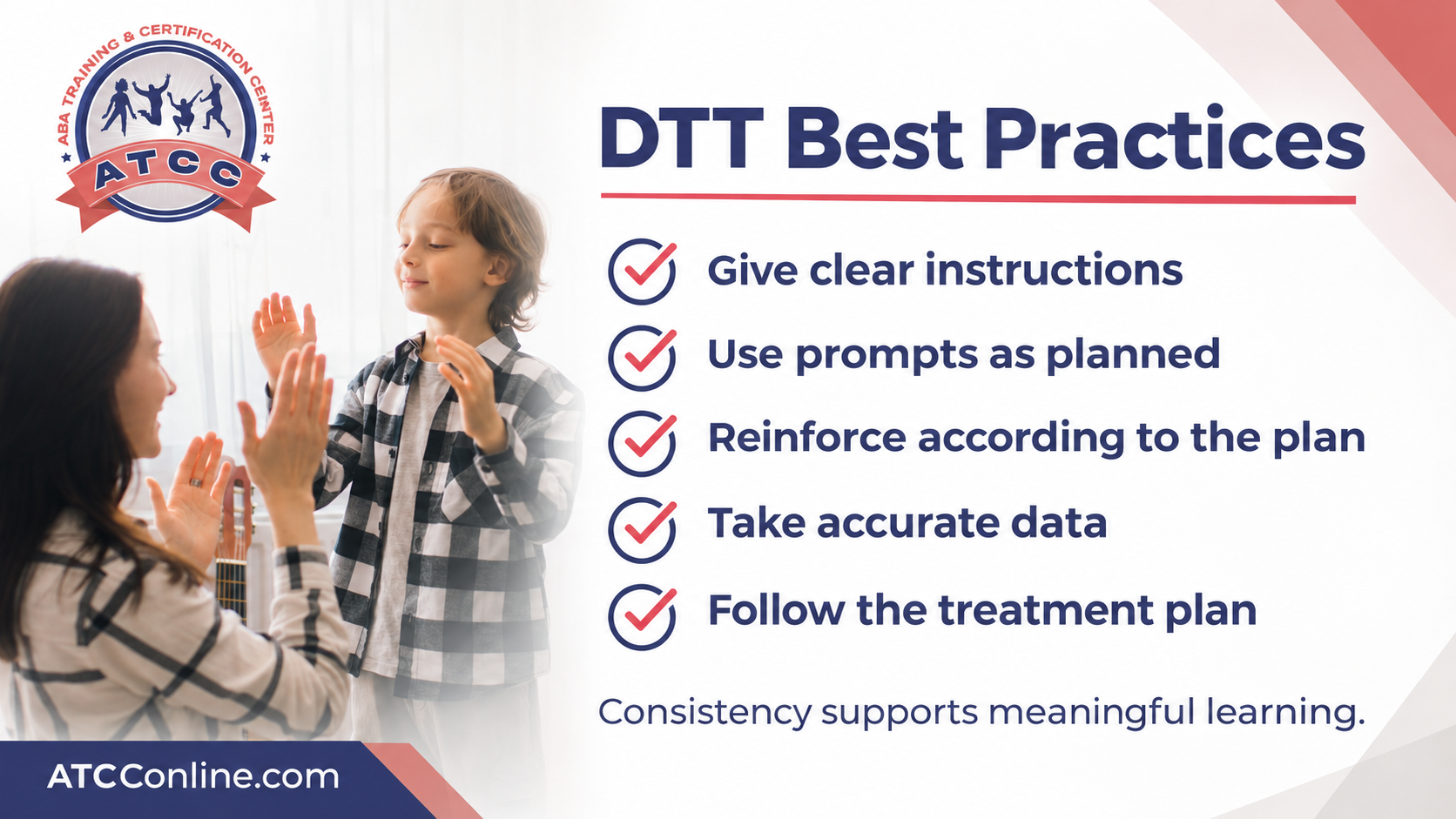
Review the teaching program before beginning
RBT®s should:
Review the teaching program before beginning
Deliver instructions clearly and consistently
Follow the planned prompting and fading procedures
Reinforce according to the treatment planUse error-correction procedures as written
Record data immediately and accurately
Avoid changing procedures without supervisor approval
Communicate concerns or patterns to the supervising BCBA®
DTT should feel structured, but it should not feel robotic. The RBT® is still responding to a real person with individual needs, preferences, and learning patterns.
Why Procedural Fidelity Matters in DTT
Procedural fidelity means implementing a teaching procedure the way it was designed.
When DTT procedures are changed unintentionally, it becomes harder for the BCBA® to know whether the teaching plan itself is working or whether the problem is related to inconsistent implementation.
Accurate implementation and accurate data help the clinical team make better decisions about the client’s progress.
Final Takeaway
DTT is more than repeating instructions and collecting data.
Effective DTT requires consistency, accurate prompting, appropriate reinforcement, careful pacing, and attention to how the client is responding.
For RBT®s, avoiding these common mistakes can help protect treatment integrity and support more effective teaching.
Want to build stronger ABA skills?
Effective DTT requires consistency, accurate prompting, appropriate reinforcement, careful pacing, and attention to how the client is responding.
For RBT®s, avoiding these common mistakes can help protect treatment integrity and support more effective teaching.
Want to build stronger ABA skills?
Watch DTT in Action
Understanding DTT is easier when you can see each part of the teaching process in action. In this sneak peek from ATCC’s 2026 RBT® Training (3rd Ed.), Chapter 25: Discrete-Trial Teaching, you’ll follow an RBT® as she uses DTT to teach an imitation skill. The video walks through key parts of the process, including instructions, prompting, reinforcement, data collection, and error correction. The lesson also connects directly to the RBT® Test Content Outline (3rd ed.), including C.3: Implement discrete-trial teaching procedures. Watch the video below for a practical look at how DTT is implemented during an ABA teaching session.
Frequently Asked Questions About DTT
Reviews and Testimonials
Meet Catia
Meet Catia, an ATCC alumna success story who is now an RBT®. In her testimonial, Catia shares her experience with ATCC and how the training and support helped her move forward in her RBT journey. Her story gives future RBTs a real look at how clear guidance, encouragement, and preparation can make the process feel more achievable.
Meet Maeonna
Meet Maeonna, an ATCC alumna who is now putting her training into practice in the field. Her story shows how the right support and preparation can help future RBTs build confidence, grow professionally, and take meaningful steps toward success in their ABA career.
These stories matter because becoming an RBT® is not just about completing a course. It is about building confidence, understanding ABA concepts, and preparing for a professional role that requires compassion, responsibility, and strong foundational training.

ATCC’s mission is to make ABA certifications, strategies, and therapy for children with autism accessible to everyone. We offer comprehensive ABA training—including the RBT® 2026 40‑Hour Training Requirements and the RBT® Test Content Outline (3rd ed.)—alongside the RBT® Competency Assessment, Full RBT® Certification Program, Rapid RBT® Exam Prep, AB-1172 School Behavioral Training, Parent & Caregiver Training, and Remote BCBA® Supervision for graduate students, all designed to empower those working with children diagnosed with Autism Spectrum Disorder (ASD).
1-877-770-2822
SUPPORT@ATCCONLINE.COM
AFFILIATE PROGRAM
CONTACT US
1-877-770-2822
SUPPORT@ATCCONLINE.COM
AFFILIATE PROGRAM
CONTACT US