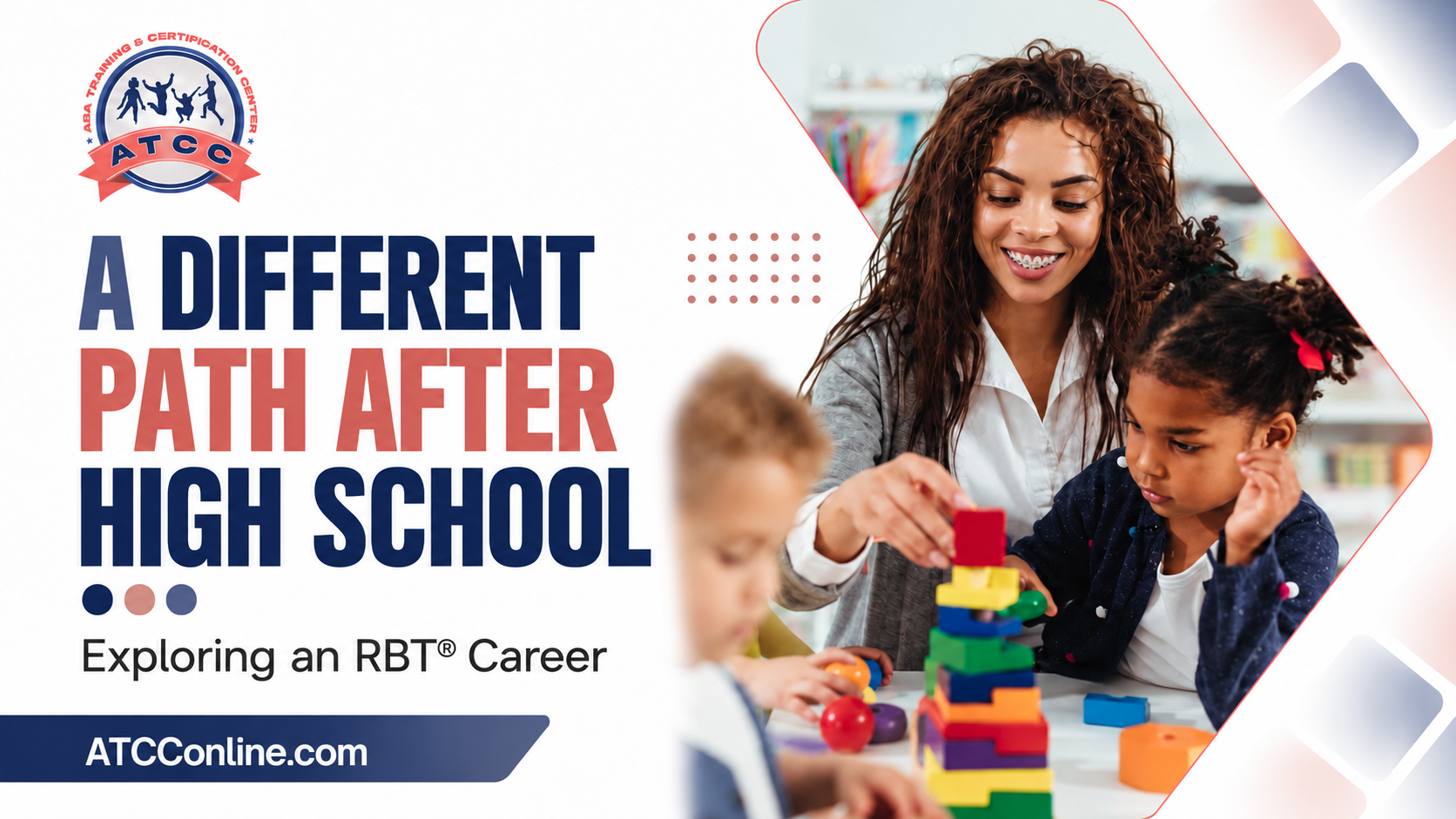
Short answer: Yes. You do not need a four-year college degree to become a Registered Behavior Technician® (RBT®). You must be at least 18, have a high school diploma or GED, pass a background check, complete the 40-hour RBT® training and a competency assessment, and pass the RBT® exam. Reviewed by Katie Walton, M.Ed., BCBA, Founder & Executive Director of ATCC. Last updated October 2026.
If you’re looking for a hands-on career where you can help others build meaningful skills, becoming a Registered Behavior Technician® (RBT®) may be worth exploring.
RBT®s work directly with clients and help support skills such as communication, social interaction, learning, and daily living. Depending on the setting, they may help clients practice new skills, follow structured teaching plans, collect data, and support progress toward individualized goals. It is a structured, supervised role that can give you real-world experience in Applied Behavior Analysis (ABA) while allowing you to work closely with people and see the progress that can come from consistent support.
For someone who wants to start building career experience sooner, work in a role focused on supporting others, or learn more about ABA before choosing a longer-term path, RBT® work can be a practical place to begin.
Watch the Video: Exploring an RBT® Career After High School
Do You Need a College Degree to Become an RBT®?
A four-year college degree is not required to begin the RBT® certification process.
That makes the RBT® path worth exploring for people who want to start building experience sooner while learning practical skills in ABA, behavioral health, education, or related fields.
You still need to meet BACB® eligibility and certification requirements, including completing the required training, competency assessment, application, and RBT® exam.
What Are the Requirements to Become an RBT®?
✔ Be at least 18 years old
✔ Have a high school diploma or GED
✔ Pass a background check
✔ Complete the 40-hour RBT® training
✔ Complete the Initial Competency Assessment with a qualified BACB®-certified assessor
✔ Submit your BACB® application
✔ Pass the RBT® exam
Requirements are set by the BACB® and can change, so always confirm the current details at BACB.com.
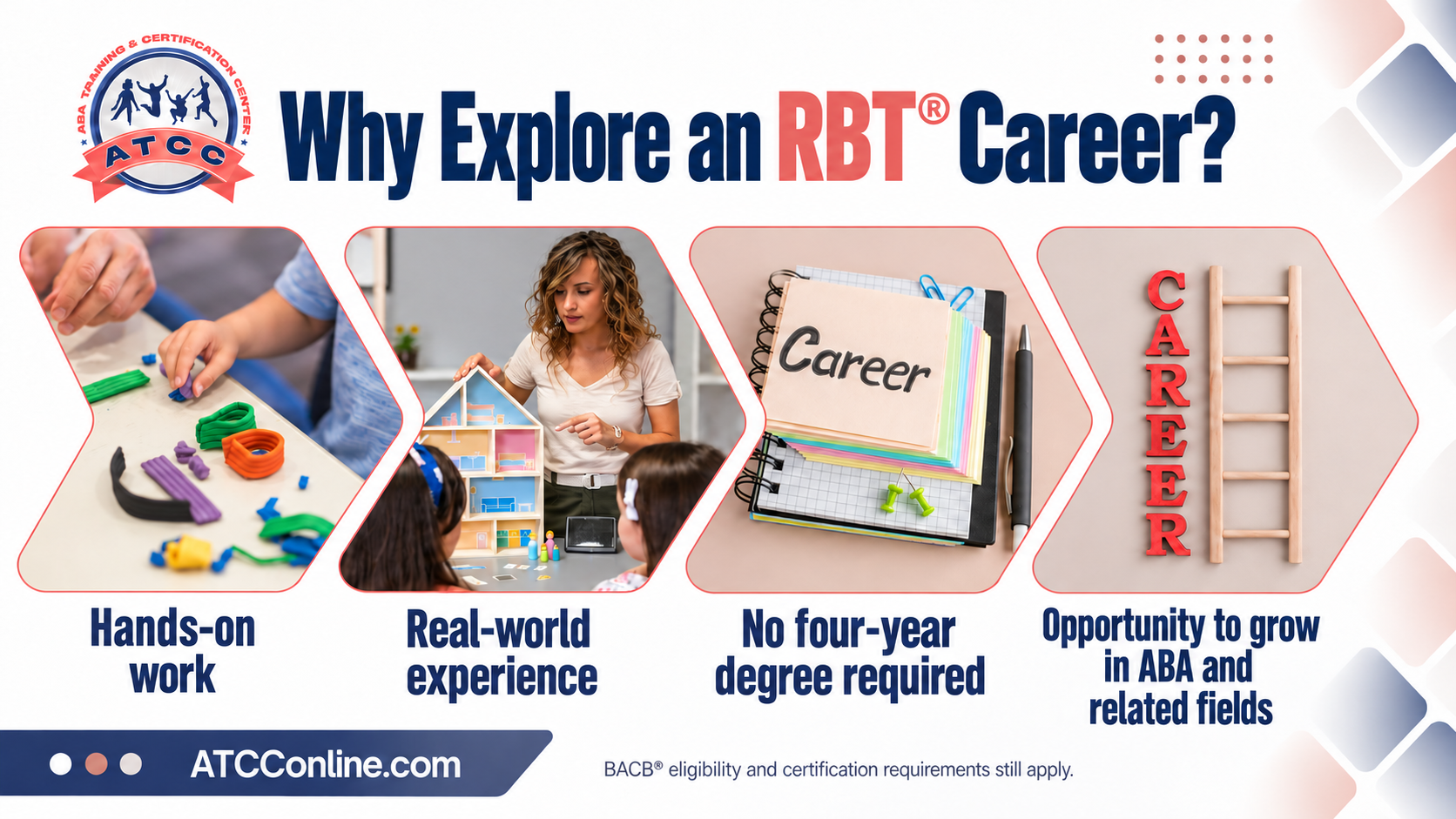
Why Consider an RBT® Career After High School?
RBT® work may appeal to you if you:
Prefer hands-on learning
Prefer hands-on learning
Enjoy working directly with people
Want to start gaining career experience sooner
Are interested in psychology, education, autism services, or behavioral health
Want to explore ABA before deciding whether to pursue more education
For some people, becoming an RBT® becomes a long-term career. For others, it becomes the beginning of a larger professional journey.
Where Can the RBT® Path Lead?
Working as an RBT® can introduce you to the broader field of Applied Behavior Analysis.
Some RBT®s later continue their education and pursue credentials such as BCaBA® or BCBA®. Others use their experience as they explore careers in education, psychology, behavioral health, special education, or human services.
You do not need to have your entire future planned out before you begin.
Sometimes the best next step is simply choosing an opportunity that helps you gain experience, build confidence, and discover what kind of work you enjoy.
Ready to Explore RBT® Training?
ATCC offers different RBT® training options depending on the level of support you need.
If you mainly need the required coursework, ATCC’s 40-Hour RBT® Training may be a good place to start.
If you want more guidance through the certification process, ATCC’s Full RBT® Certification Program provides a more supported pathway.
If you mainly need the required coursework, ATCC’s 40-Hour RBT® Training may be a good place to start.
If you want more guidance through the certification process, ATCC’s Full RBT® Certification Program provides a more supported pathway.
Choose Your RBT® Path with ATCC
Not every future RBT® starts from the same place.
If you already have access to a BCBA® or employer who can help with the certification steps after training, ATCC’s 40-Hour RBT® Training gives you a flexible way to complete the required coursework and prepare for what comes next.
If you’re starting without that support, the Full RBT® Certification Program may be a better fit. Instead of piecing together each step on your own, you’ll receive guidance with the competency assessment, BACB® application, exam preparation, and other parts of the certification process.
Watch the video below for a quick look at both options and decide which path fits where you are right now.
Frequently Asked Questions About Becoming an RBT®
Reviews and Testimonials
Meet Catia
Meet Catia, an ATCC alumni success story who is now an RBT®. In her testimonial, Catia shares her experience with ATCC and how the training and support helped her move forward in her RBT® journey. Her story gives future RBTs® a real look at how clear guidance, encouragement, and preparation can make the process feel more achievable.
Meet Maeonna
Meet Maeonna, an ATCC alumni who is now putting her training into practice in the field. Her story shows how the right support and preparation can help future RBTs® build confidence, grow professionally, and take meaningful steps toward success in their ABA career.
These stories matter because becoming an RBT® is not just about completing a course. It is about building confidence, understanding ABA concepts, and preparing for a professional role that requires compassion, responsibility, and strong foundational training.
ATCC’s mission is to make ABA certifications, strategies, and therapy for children with autism accessible to everyone. We offer comprehensive ABA training—including the RBT® 2026 40‑Hour Training Requirements and the RBT® Test Content Outline (3rd ed.)—alongside the RBT® Competency Assessment, Full RBT® Certification Program, Rapid RBT® Exam Prep, AB-1172 School Behavioral Training, Parent & Caregiver Training, and Remote BCBA® Supervision for graduate students, all designed to empower those working with children diagnosed with Autism Spectrum Disorder (ASD).
1-877-770-2822
SUPPORT@ATCCONLINE.COM
AFFILIATE PROGRAM
CONTACT US
1-877-770-2822
SUPPORT@ATCCONLINE.COM
AFFILIATE PROGRAM
CONTACT US