Discrete Trial Training in ABA: A Complete Beginner’s Guide

Aug 11 / Alen Faye Crisostomo, BS, RBT

RBT® Training Options

Write your awesome label here.

✅ 87.2% first-time pass rate on the RBT® board examination!

📚 4 study resources, $1,196 value — now free upon completion of the ATCC® 40-hour RBT Training course.
💬 AI-powered practice support! 

Discrete Trial Training, or DTT, is a structured teaching method commonly used in Applied Behavior Analysis (ABA). It helps learners build new skills by breaking larger goals into smaller, manageable teaching opportunities.

For future Registered Behavior Technicians® (RBT®s), understanding DTT is important because it brings together several core ABA concepts, including prompting, reinforcement, data collection, and skill acquisition.
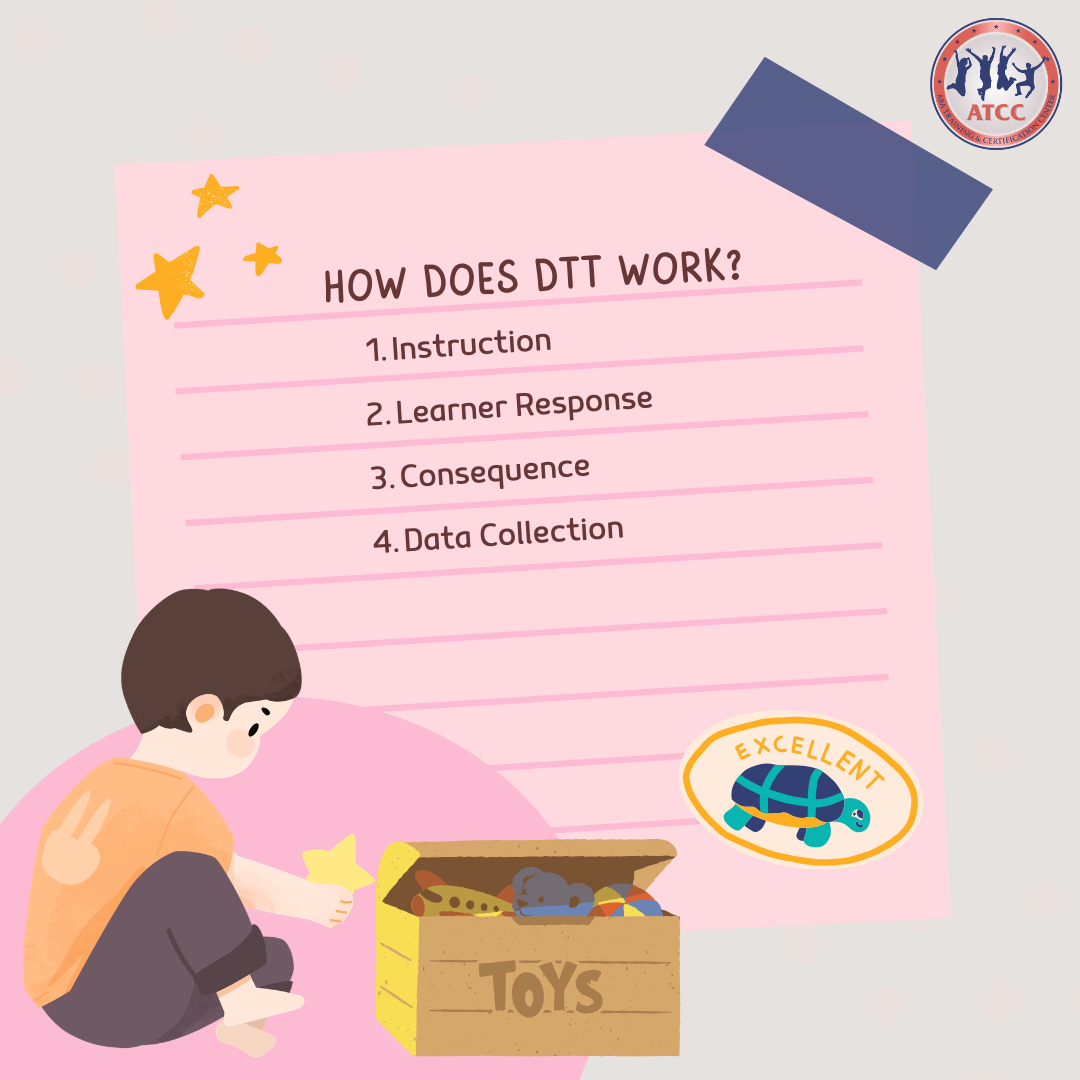
Each discrete trial has a clear beginning and end. A typical teaching opportunity may include:

  1. Instruction: The RBT® presents a clear direction or cue.
  2. Learner Response: The learner is given an opportunity to respond.
  3. Consequence: Reinforcement or an error-correction procedure is provided based on the learner’s response.
  4. Data Collection: The RBT® records what happened during the triaL

For example, an RBT® may place several colored cards on a table and say, “Touch blue.” If the learner touches the blue card, the RBT® may provide reinforcement according to the treatment plan and record the response.


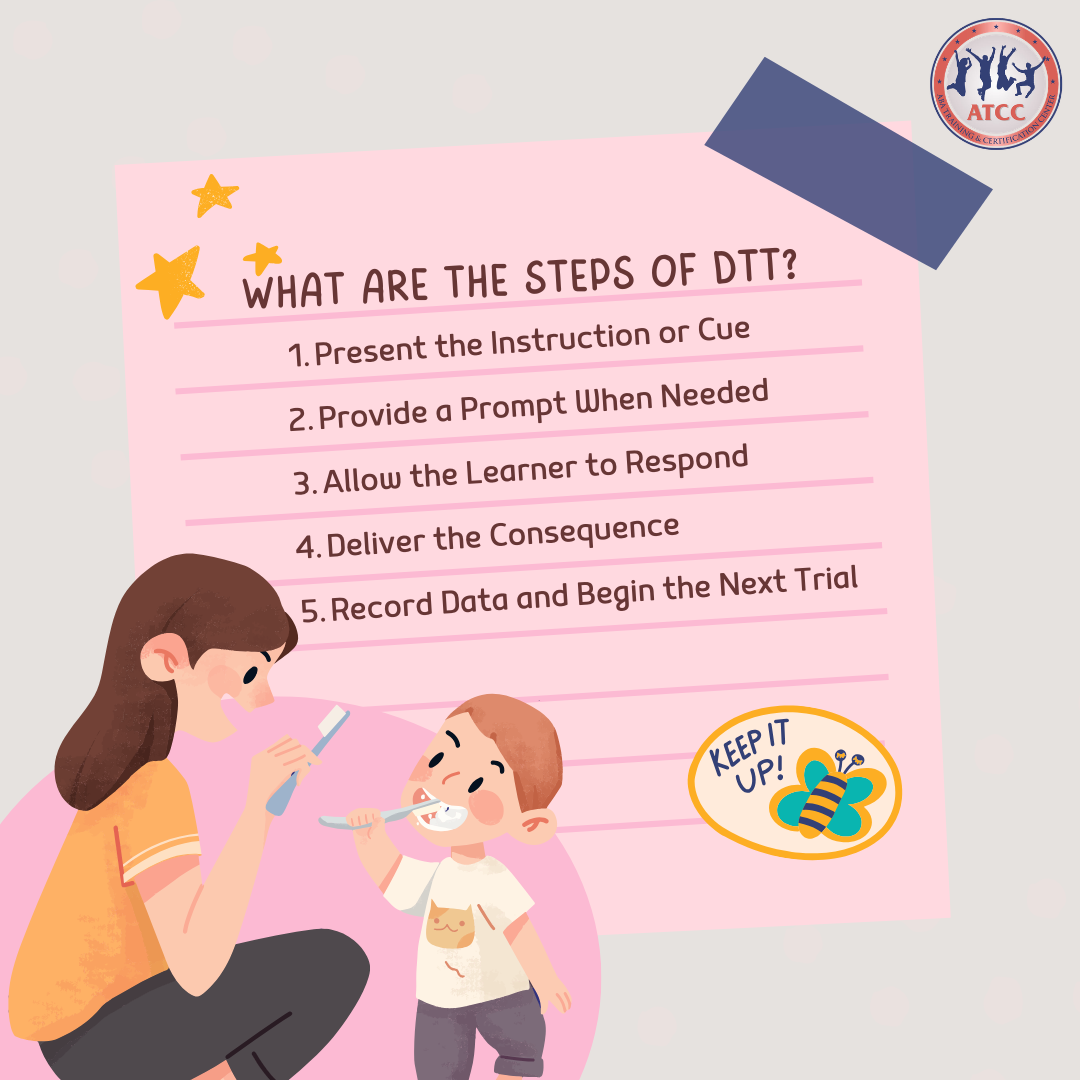
1. Present the Instruction or Cue

The teaching opportunity begins with an antecedent.

This may include a discriminative stimulus, often called an SD, which signals that reinforcement may be available for a particular response.

For example:

“Clap your hands.”

“Point to the dog.”

“Give me the spoon.”

“What color is this?”

The instruction should be delivered according to the learner's treatment program.

2. Provide a Prompt When Needed

Some learners may need assistance when learning a new skill.

Depending on the program created by the supervising behavior analyst, prompts might include:

  • Gestural prompts
  • Model prompts
  • Verbal prompts
  • Visual prompts
  • Physical prompts

The goal is not for the learner to remain dependent on prompts.

As the learner develops the skill, prompting may be systematically faded according to the behavior plan so that the learner can respond more independently.


3. Allow the Learner to Respond

After the instruction is presented, the learner has an opportunity to respond.

Responses may be recorded as independent, prompted, incorrect, or according to whatever data system has been established by the supervising BCBA®.

The RBT® should follow the treatment plan rather than independently changing how the response is scored.


4. Deliver the Consequence

What happens immediately after the learner's response is an important part of the teaching process.

When the learner produces the target response, reinforcement may be delivered according to the treatment plan.

Reinforcement could include:

  • Praise
  • Access to a preferred toy
  • Tokens
  • A preferred activity
  • Other individualized reinforcers

If the learner responds incorrectly, the RBT® follows the specified error-correction procedure.


5. Record Data and Begin the Next Trial

Data collection is one of the most important parts of DTT.

The RBT® may record whether the learner responded independently, required a prompt, or responded incorrectly.

A brief pause may occur before the next teaching opportunity begins.

Over multiple trials and sessions, this data helps the supervising behavior analyst evaluate whether the learner is progressing.

How to Use DTT Effectively

To maximize the effectiveness of DTT, follow these best practices:
  • Use Reinforcement: Always reward correct responses with meaningful reinforcement (praise, stickers, tokens, etc.).
  • Fade Prompts Gradually: The goal is for the learner to become independent, so prompts should be reduced over time.
  • Keep Sessions Short and Engaging: Short, frequent sessions are more effective than long, tiring ones.
  • Track Progress: Data collection helps determine when a skill is mastered and when adjustments are needed.
  • Make Learning Fun: Incorporate engaging activities and rewards to keep the learner motivated.
DTT is not just a strategy; it’s a powerful tool that unlocks learning potential. Whether used in a classroom, therapy session, or at home, its structured approach, combined with effective prompting, ensures that learners build essential skills step by step. By understanding and leveraging the power of DTT, educators, parents, and therapists can create meaningful learning experiences that lead to lasting success. So, are you ready to unleash the full power of DTT? 

Keep Learning with ATCC®

This sneak peek video gives future RBTs® a practical look at Discrete-Trial Teaching (DTT) and how this structured ABA teaching method is used to build new skills.

It shows how an RBT® can break learning into clear, step-by-step trials using instructions, prompting, reinforcement, data collection, and error correction. The video follows Emma, an RBT®, as she teaches imitation skills and demonstrates how each part of DTT fits together.

ATCC’s 2026 40-Hour RBT® Training helps students build a stronger understanding of ABA teaching procedures while seeing how concepts like DTT may look in real practice.
Write your awesome label here.
Guaranteed Security using one of the most advanced encrypted systems on the market.
The information in this page is being processed and encrypted securely using industry-leading encryption and fraud prevention tools.

Guaranteed Security using one of the most advanced encrypted systems on the market.
The information in this page is being processed and encrypted securely using industry-leading encryption and fraud prevention tools.


Latest from our blog